
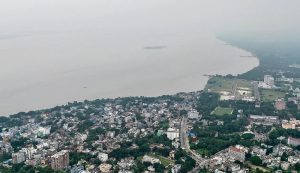
New Delhi: India and Bangladesh have begun formal talks on renewing the Ganges water sharing treaty, signed in 1996. The treaty is set to expire in December 2026, exactly 30 years after its signing. According to officials, both countries have started joint measurement of water levels in the Ganges and Padma rivers since Thursday. This measurement will be recorded every 10 days and will continue until May 31.
This step is in line with the provisions of the treaty, which governs water sharing at the Farakka Barrage during the dry season (January to May). As the treaty enters its final year, both countries are discussing its renewal to ensure continuity in regional water management. Saurabh Kumar, Deputy Director, and Sunny Arora, Assistant Director, of the Indian Central Water Commission (CWC) are in Bangladesh, while a four-member Bangladeshi team, led by Arifin Zubed, Executive Engineer of the North-Eastern Measurement Hydrology Division of the Bangladesh Water Development Board, is in India.
The measurement work has commenced at a point 3,500 feet above the Harding Bridge on the Padma River and at the Farakka point in India. The Padma River is a major river in Bangladesh, which is the main stream of the Ganges River coming from India and is known by this name after entering Bangladesh. Shibbir Hossain, a senior official of the Bangladesh Ministry of Water Resources, said that special attention is being given to the security of the Indian team. The Ministry of Water Resources has written to the Ministry of Home Affairs to ensure additional security arrangements.
What is the treaty and its significance?
The 1996 Ganges Water Treaty is a crucial bilateral agreement between India and Bangladesh that provides for the sharing of Ganges water during the dry season at the Farakka Barrage. This treaty was a landmark in resolving the long-standing water dispute between the two countries. However, due to climate change, increasing irrigation needs, and development projects, both sides are seeking modifications in the new treaty. India is seeking amendments to the treaty, citing its growing water needs (for irrigation, port maintenance, and power generation), while Bangladesh is appealing for a greater share of water during the dry season, as agriculture and livelihoods in its southwestern regions are being affected. Both countries are also working towards enhancing cooperation on the 54 shared rivers, although agreements currently exist only for the Ganges and a few others. Experts believe that the renewal negotiations could lead to a more climate-resilient and inclusive agreement.
According to the provisions of the treaty, both countries will measure water levels at various specified points on the Ganges and Padma rivers from January 1 to May 31 and record the data every 10 days.
Share:










Indore (HO)
Bhopal
Jabalpur


©2026 Agnibaan , All Rights Reserved