
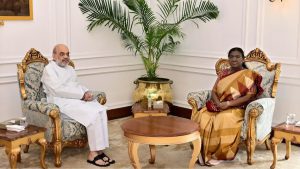
New Delhi: Tuesday, 5 August 2025 is going to be a milestone for Amit Shah in many ways. Firstly, Amit Shah is going to make the record of being the longest-serving Home Minister by breaking the record of Lal Krishna Advani, who held the post of Home Minister for 6 years and 64 days. Secondly, there is also a discussion that soon the Modi government is going to give full statehood status to Jammu and Kashmir. If this happens, then Amit Shah will also announce it, as he had declared Jammu and Kashmir and Ladakh as Union Territories while announcing the abolition of Article 370 on 5 August 2019.
In fact, on Sunday, both PM Modi and Amit Shah had separately met President Murmu. Secondly, tomorrow is 5 August. On 5 August 2019, Article 370 was revoked from Jammu and Kashmir and Jammu and Kashmir and Ladakh were made separate union territories. Tuesday, i.e. tomorrow is 5 August. In such a situation, the meeting between Amit Shah and the President has intensified the political stir. One big reason is that such meetings usually do not happen at all. It is not normal for these two leaders to meet the President on the same day and with a difference of a few hours. The question arises whether the government is going to bring a big bill in the Parliament, about which PM Modi and the Home Minister have come to inform the President. This is the reason why many speculations are being made.
The discussion of giving full statehood status to Jammu and Kashmir has been going on since the repeal of Article 370 and 35A on 5 August 2019. Ever since the special status of Jammu and Kashmir was removed and divided into two union territories Jammu and Kashmir and Ladakh. Since then, the demand for restoration of full statehood status is being made by local leaders and parties. Home Minister Amit Shah and Prime Minister Narendra Modi had promised in Parliament in 2019 that full statehood would be restored to Jammu and Kashmir at an appropriate time. After that, the Government of India has also said several times that it will restore full statehood when the time comes. The Supreme Court also ordered the restoration of statehood in 2023.
In fact, as a Union Territory, the government of Jammu and Kashmir has limited powers. Important matters like police, law and order, and All India Services are controlled by the Lieutenant Governor and the Central Government. Parties like the National Conference (NC), People’s Democratic Party (PDP), and Congress have been continuously demanding full statehood. NC leader Omar Abdullah made it the main agenda of his government and won 42 seats in the 2024 assembly elections.
To grant full statehood, amendments are necessary in the Jammu and Kashmir Reorganization Act, 2019, which will require the final approval of President Draupadi Murmu after the approval of the Lok Sabha and Rajya Sabha. After their approval, when the notification is issued, Jammu and Kashmir will get the status of a full state. The President’s separate meeting with the PM and the Home Minister on Sunday has led to speculations that this meeting is for Jammu and Kashmir. It is very likely that tomorrow, on the sixth anniversary of the abrogation of Article 370, the government will announce the restoration of statehood to the people of Jammu and Kashmir.
With the Jammu region being Hindu-dominated and the Kashmir Valley being Muslim-dominated, there has often been a discussion on whether it is possible to give separate statehood to both. The people of Jammu have been complaining that the Kashmiri leadership ignored the development of their region and did not give them proper representation in power. In this context, the demand for making Jammu a separate state is seen by some as regional empowerment.
Those who are in favor of giving Jammu a separate statehood argue that this will better address the specific needs and identity of the region. Jammu will give Hindus a respectable identity and development opportunities, which is not possible in solidarity with Kashmir. Kashmiri journalist @AartiTikoo writes on X that… There is a rumour going around in Jammu and Kashmir these days that the central government may give statehood to this union territory again on the sixth anniversary of the abrogation of Article 370, that is, tomorrow. And what is even more shocking is that the rumour market is saying that Kashmir and Jammu will be separated and two independent states will be formed.
If any of these things turn out to be true, then this will be a very disastrous step. This will basically be like implementing the Dixon Plan – that is, the division of Jammu and Kashmir on religious grounds, due to which the Muslim majority area will be indirectly handed over to Pakistan. It is not possible to keep any Muslim majority area bordering India unaffected by the Pakistani army and its jihadi terrorists.
If it is argued that Hindu-dominated Jammu has been deprived of political power in proportion to its population, and has been discriminated against by the Muslim-dominated Kashmiri leadership – then it is clear that if the two-nation theory of Iqbal, Jinnah and now General Asim Munir has succeeded anywhere in India, it is Jammu and Kashmir. And if they succeed in Jammu and Kashmir today, tomorrow they will succeed in other parts of India too – be it tomorrow, day after tomorrow, or years later.
India’s foundation rests on its ancient pluralistic philosophy, ideas of equality and freedom. The partition of Jammu and Kashmir on religious grounds will destroy India as an ideology. It will be nothing but a grave and tragic tragedy. Amit Shah has left his impressive mark in his tenure as Home Minister, not only in Jammu and Kashmir but also in other areas of the country. From 2019 till now (till August 2025), the Home Ministry under his leadership has taken many important steps in security, administrative efficiency, and social reforms.
-The abolition of Article 370 ended the special status of Jammu and Kashmir, opening new possibilities of unity and development in the region. Assembly elections were held for the first time as a Union Territory in 2024, in which 60% voting promoted peace and public participation. Shah has also contributed to peace in the North-East. Relaxing AFSPA was a big decision of his. In 2024, Amit Shah announced the repeal of the Armed Forces (Special Powers) Act (AFSPA) in Assam, Arunachal Pradesh and Manipur, restoring peace and confidence in the region.
-The signing of the agreement to resolve the Bodo problem in 2020 curbed insurgency activities, which led to development. Shah launched Operation Prahar in Naxal-affected areas, resulting in a 70% reduction in Naxal incidents in 2023-24. Deployment of security forces was increased in Chhattisgarh and Jharkhand. Setting a deadline for the elimination of Naxalism will go down in Indian history as Shah’s biggest success.
-Replacement of the Indian Penal Code (IPC): In 2023, a law was enacted to replace the IPC, CrPC, and Evidence Act with the Indian Judicial Code, the Indian Civil Defence Code and the Indian Evidence Act respectively. Which were in existence since the British Raj. Citizenship Amendment Act (CAA): Shah led a nationwide awareness campaign on the CAA, enacted in 2019, which was to come into effect in 2024.
Share:







Indore (HO)
Bhopal
Jabalpur


©2026 Agnibaan , All Rights Reserved