
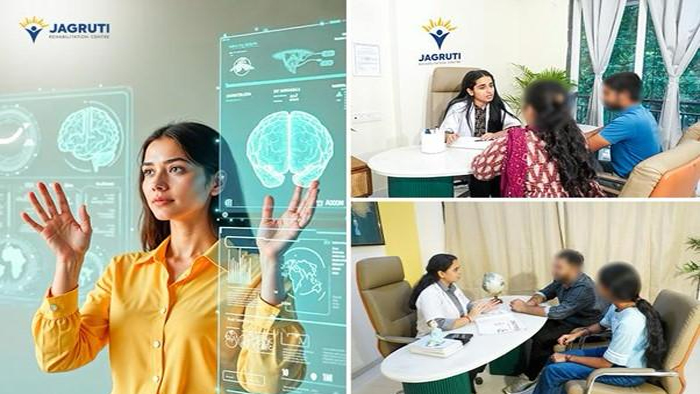
As AI dependency is rapidly growing worldwide, people have recently started using it in the medical field. From AI chatbots for mental and emotional support to AI-generated health apps for health checkups, people are becoming addicted to several AI-based tools for healthcare support. Not only adults but a huge number of teenagers are preferring AI tools rather than professional help for health-related guidance. But can AI really be a good replacement for a human therapist? Doctors at Jagruti rehabilitation centre in Pune have opened up about this question.
Using a real-life patient case as an example, Jagruti’s doctors explained the limitations and risks of using AI for health support.
Reasons behind the Rapid Rise of AI in Medical Care
People of this era trust the solution given by AI more than a doctor’s advice. There are some major reasons why the demand for AI for health guidance is increasing with every passing day. Artificial Intelligence works faster than a normal human doctor can. Since people are getting immediate answers for a health-related query, they are finding AI more appealing and useful. Unlike human doctors, AI tools never get tired, offering guidance 24/7 whenever needed. Users can ask for medical guidance anytime from anywhere on AI apps. This is why today’s generation is rapidly choosing AI over doctors for medical care.
A large number of people, especially teenagers, can’t share their stress, anxiety or mental condition with anyone. They find it easy to share their problems with ChatGPT rather than parents or a human friend. This leads to the constant rise of artificial intelligence in medical care.
Risk of Trusting AI too much
At Jagruti rehab centre in Pune, doctors are saying that depending on AI every time for emotional support or medical care can be dangerous. Here are some possible risks you can face when you trust AI too much for medical guidance:
Wrong Information
Specialists find out that AI works based on pre-programmed data. So, the information AI is offering is not 100% correct every time. It is very much possible that AI may provide wrong information about a disease that can mislead a person to choose the wrong treatment or medicine.
Deadly Advice
There are several real-life cases where AI suggested users take some dangerous steps for their better health, which caused death.
Lack of Social Connection
When people start preferring AI for mental support instead of a human friend, they may lack interest in socially connecting with others.
Privacy Violations
When you are asking for medical help from an AI tool, you need to put your health information into the chatbot. Since AI chatbots can’t ensure 100% security, they may leak your sensitive information, exposing your health issues on social networks.
Increased screen time
One of the doctors at Jagruti de-addiction centre in Pune has shared a real case of a patient who came for treatment. He started using AI to learn some weight-loss strategies. But slowly, he became addicted to it so much that he spent almost the entire day using it. So, it’s proof that AI can increase your screen time if you are using it for everything.
AI Is A Support Tool, Not A Replacement for Doctors
Experts at Jagruti rehab centre in Pune clarified that AI can work as a support tool in some medical cases. It can create a structured daily routine, help in habit tracking or provide early alertness for a health issue. But it should not be used in critical cases like chronic addiction, extreme depression, phobia or post-surgery trauma. The treatment plan it creates may lack customization, which results in inappropriate treatment. Thus, AI can never replace the efficiency of a therapist.
Human Touch Always Matters
Jagruti’s professionals are saying that only a human touch works best for addiction treatment or mental therapy. The way human therapists understand the exact situation of a patient and provide appropriate guidance, AI can never do that. AI may improve in future, but human touch will always be a necessary part in medical care.
AI and Humans- A Balanced Combination for Future Medical Health
The truth is, AI is neither completely harmful nor completely beneficial for medical support. Using it rightly and for a limited period can help patients in several ways. In the future, combining AI technology with professional human support will set a new benchmark in the medical field.
Share:













Indore (HO)
Bhopal
Jabalpur


©2026 Agnibaan , All Rights Reserved