
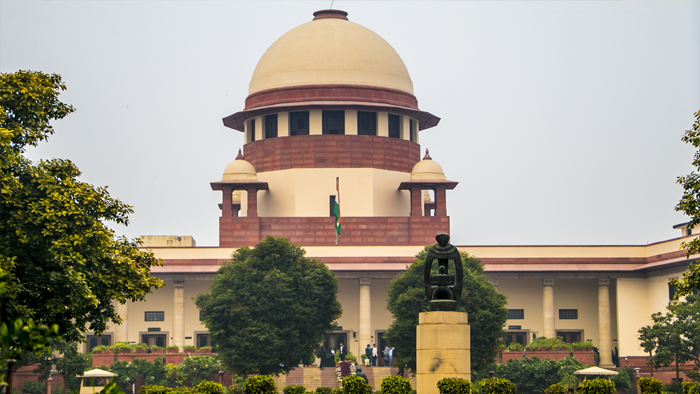
Desk: The Supreme Court on Wednesday said that the establishment of additional trial courts would strengthen the judicial system. Accused persons in criminal cases would not need to approach the Supreme Court for relief such as bail or speedy trial. On January 6, the Supreme Court had asked the Centre and the Delhi government to consider setting up a special court to conduct day-to-day hearings in a 2021 case being investigated by the National Investigation Agency related to a person’s alleged links with ISIS.
No one should need to come to the courts – Chief Justice
On Wednesday, a bench of Chief Justice of India Surya Kant and Justices Joymalya Bagchi and Vipul M Pancholi asked Additional Solicitor General Aishwarya Bhati, appearing for the central government, about the progress made in setting up a special court in the national capital. The Chief Justice said, “The idea is how to create a robust mechanism so that none of them need to come to the courts? And that will only happen when additional courts are established.” The bench asked the law officer to provide information on the progress made towards setting up a special court here by February 10. The matter will now be heard on the same day.
What is the case?
The bench was hearing the bail plea of Mohammad Heydaitullah, who is accused of using Telegram groups to propagate the ideology of the terrorist group in India and recruit other individuals. Earlier, the Chief Justice had said that excessive delay in the trial could give rise to a legitimate argument from the accused that he cannot be kept in custody for a long period, especially without a trial. The bench had asked Bhati to provide information within a week about the special court that has been set up here to conduct day-to-day hearings in the case, in which 125 witnesses are to be examined. In an ISIS-related case, the Delhi High Court had denied bail to Heydaitullah, an alleged member of the terrorist organization, in a case related to radicalizing youth using cyberspace.
The High Court had rejected this argument.
The accused had challenged the lower court’s order refusing to grant any relief on the ground that merely being associated with or supporting a terrorist organization would not constitute an offense under the Unlawful Activities (Prevention) Act. The High Court rejected this argument and stated that Heydaitullah, a qualified MBA graduate working in an IT company in Gurugram, was not a passive supporter, as the evidence showed that he had advocated for “jihad to establish a caliphate,” even through violent means. The High Court observed, “The appellant has admitted that he took an oath of allegiance (bayat) in 2018 in the name of Abu Bakr al-Baghdadi and Abu al-Hasan al-Hashimi al-Qurashi. Abu Bakr al-Baghdadi is a well-known leader of ISIS, and according to the charge sheet, he had declared the establishment of a ‘caliphate’ in June 2014.”
Share:













Indore (HO)
Bhopal
Jabalpur


©2026 Agnibaan , All Rights Reserved