
New Delhi. China has consistently questioned India’s security by building large dams near the Indian border. Now, the Indian government is responding appropriately to this Chinese move. The Central Electricity Authority (CEA) announced on Monday that, in response to the growing demand for electricity, the government has prepared a ₹6.4 trillion plan to build approximately 76 gigawatts of hydropower capacity in the Brahmaputra River basin by 2047.
In a report released on Monday, the CEA stated that this plan will significantly develop hydropower projects in the Northeast. It will include a total of 208 large hydropower projects across 12 sub-basins, with a potential capacity of approximately 64.9 gigawatts and an additional pumped storage capacity of approximately 11.1 gigawatts.
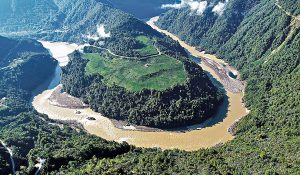
This plan by the CEA comes at a time when China is planning to build a massive hydropower project on the upper reaches of the Brahmaputra River, which originates in Chinese-occupied Tibet. The river originates in Tibet, flows through India and Bangladesh, and empties into the Bay of Bengal. The river serves as a vital lifeline for Arunachal Pradesh.
This project being built by China and the location of the Brahmaputra basin along the border pose a security and strategic concern for India. India’s biggest fear is that a Chinese dam on the Yarlung Zangbo (the upper reaches of the Brahmaputra River before it enters India) could significantly reduce the flow of water to India. Furthermore, in the event of war, China could use this dam as a water bomb. Amidst such threats, this project for India becomes even more important. Furthermore, it could better utilize the hydropower available in the Brahmaputra basin.
According to the CEA report, the Brahmaputra basin spans Arunachal Pradesh, Assam, Sikkim, Mizoram, Meghalaya, Manipur, Nagaland, and parts of West Bengal, and holds over 80 percent of India’s untapped hydropower potential. Arunachal Pradesh alone accounts for 52.2 percent of this.
According to the plan, the first phase will be completed by 2035 and will require approximately ₹1.91 trillion, while the second phase will cost ₹4.52 trillion. The CEA plan also includes projects allocated to central public sector companies such as NHPC, NEEPCO, and SJVN, some of which are already in the pipeline. It is noteworthy that India aims to reduce its dependence on fossil fuels by achieving 500 GW of non-fossil power generation capacity by 2030 and net zero power generation capacity by 2070.
Share:












Indore (HO)
Bhopal
Jabalpur


©2026 Agnibaan , All Rights Reserved