
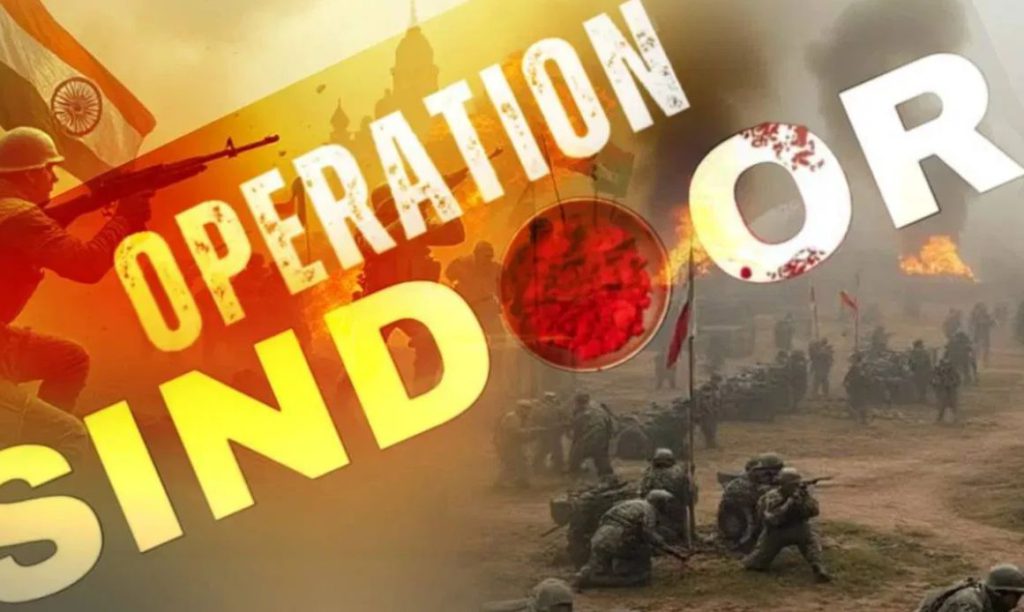
New Delhi: The Indian Army has detailed its major achievements in 2025. These include Operation Sindoor, new capabilities, technology induction, military diplomacy, and indigenization efforts. The biggest development in the military sphere this year was Operation Sindoor, which was launched in May 2025 following the Pahalgam terrorist attack by Pakistan Army-backed terrorists. The entire operational plan was prepared by the Indian Army’s Military Operations Branch. Its execution was monitored from the Operations Room of the Directorate General of Military Operations, with the Chief of Defence Staff (CDS) and all three Service Chiefs present. During the operation, nine terrorist camps across the border were destroyed. Seven camps were neutralized by the Indian Army, while two were destroyed by the Indian Air Force. These attacks were precise, controlled, and timely.
The Army also described how it countered the enemy’s actions from Pakistan. On the nights of May 7-10, Pakistan attempted to target military and civilian assets using drones. Indian Army air defense units successfully neutralized all threats, preventing any damage. Along the Line of Control (LOC), more than 12 terrorist launch pads were destroyed using ground-based weapons, disrupting infiltration routes and terrorist logistics. On May 10, the Indian Army’s Director General of Military Operations was contacted by his Pakistani counterpart with an appeal for a ceasefire, following which an agreement was reached to cease firing and military operations.
Progress in Rocket Launcher Systems
The Indian Army also highlighted the progress made in the BrahMos and Pinaka multi-barrel rocket launcher systems. On December 1, the Southern Command’s BrahMos unit, in conjunction with the Andaman and Nicobar Command, conducted a live missile firing exercise, confirming high-speed flight stability and terminal accuracy in specific combat scenarios. The Army stated that work is underway on the extended-range BrahMos system. On June 24, two additional Pinaka regiments were made operational. On Monday, before the end of 2025, the Army successfully tested the Pinaka Long Range Guided Rocket, which has a reported range of approximately 120 km. The first three AH-64E Apache attack helicopters were received on July 22, while the remaining three were delivered in December. With six Apaches now operational, this unit will further strengthen the Army’s attack capabilities, posing a significant threat to enemy armored vehicles.
The Army has created new units to further strengthen its structure. In October, the Bhairav Light Commando Battalions and Ashni Drone Platoons showcased their capabilities in Rajasthan. The plan is to make 25 Bhairav battalions fully operational soon. These commando battalions are fast and lightweight, while the Ashni platoons will utilize drones for intelligence gathering, surveillance, and reconnaissance within infantry units. Additionally, new Shakti Baan regiments and Divyastra batteries are being raised, which will be equipped with unmanned systems and loitering munitions. All of this is aimed at preparing for future wars and challenges.
Emphasis on Indigenous Procurement
The Army has placed a strong emphasis on indigenous procurement of weapons and technology. The last two years have been termed the years of technology absorption, signifying the rapid adoption of new technologies. Currently, 91 percent of the ammunition used by the Army is manufactured in India. In the last year, approximately 3,000 drones have been procured, including remotely piloted aircraft, drones, logistics drones for high-altitude supply drops, and kamikaze drones. Digital transformation is also progressing rapidly, with the establishment of edge data centers and the development of in-house apps such as the Equipment Helpline and Sainik Yatri Mitra app to assist soldiers.
The Army Commanders’ Conference held in Jaisalmer in October 2025 focused on grey zone warfare (including cyberattacks, disinformation campaigns, and economic coercion), joint operations, and innovation. The Army conducted major joint exercises with countries such as France, the US, Thailand, Australia, Sri Lanka, the UK, and the UAE. This enhanced interoperability with friendly nations and strengthened regional ties. Furthermore, initiatives like Inno-Yoddha 2025-26 generated 89 new ideas, 32 of which were selected for further development. All these steps are aimed at making the Army self-reliant, modern, and future-ready.
Share:












Indore (HO)
Bhopal
Jabalpur


©2026 Agnibaan , All Rights Reserved