
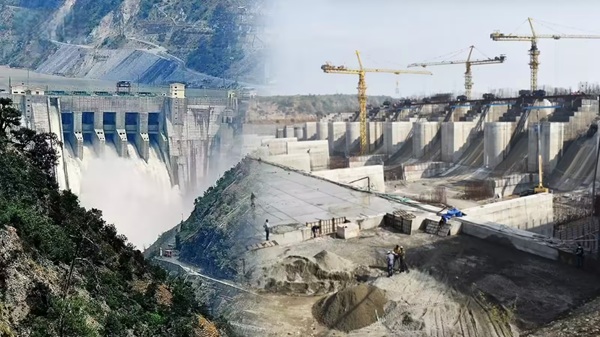
Kathua: A major shift has occurred in the politics of flowing water between India and Pakistan. The Shahpur Kandi Dam Project, located on the border of Punjab and Jammu and Kashmir, is in its final stages. Once operational, the Ravi River water that previously flowed to Pakistan will now be fully utilized by India. This water will primarily be used to irrigate the dry lands of Jammu and Kashmir and Punjab. Jammu and Kashmir Minister Javed Ahmed Rana stated that the dam is expected to be completed by March 31. This project will prove to be a lifeline, especially for the Kathua and Samba districts.
Major Contribution to Irrigation and Economic Development
The Shahpur Kandi Dam will not only conserve water but also boost the regional economy. This will enable irrigation of over 32,173 hectares of land in Jammu and Kashmir’s Kathua and Samba districts and approximately 5,000 hectares in Punjab. The central government has approved assistance of ₹485.38 crore for the irrigation component. The completion of the dam will provide a new impetus to power generation and agricultural development in the region.
Indus Water Treaty and India’s New Strategy
Under the 1960 Indus Water Treaty, India has exclusive rights over the eastern rivers such as the Ravi, Beas, and Sutlej. Due to technical constraints and the lack of dams, much of the water has previously flowed to Pakistan. Recently, India has taken a tough stance against Pakistan, halting data sharing under the treaty, and is exploring the possibility of maximizing the utilization of the western rivers (Indus, Jhelum, and Chenab). Jammu and Kashmir MLA Dr. Rameshwar Singh stated that once the dam is operational, the water will no longer flow to Pakistan but will instead be used for agriculture and greenery in the Kathua region.
Decades of Waiting and Political Initiatives
2001: The project was first approved, but work stalled due to interstate disputes.
2018: An agreement was reached between Punjab and Jammu and Kashmir after Prime Minister Narendra Modi’s intervention.
Currently: The project is in mission mode to stop water from flowing to Pakistan.
Officials say this move is not only crucial for agriculture, but also holds strategic importance from the perspective of cross-border terrorism and diplomatic pressure. Pakistan is already facing a water crisis, and India’s full use of its share of water could further exacerbate this crisis.
Share:













Indore (HO)
Bhopal
Jabalpur


©2026 Agnibaan , All Rights Reserved