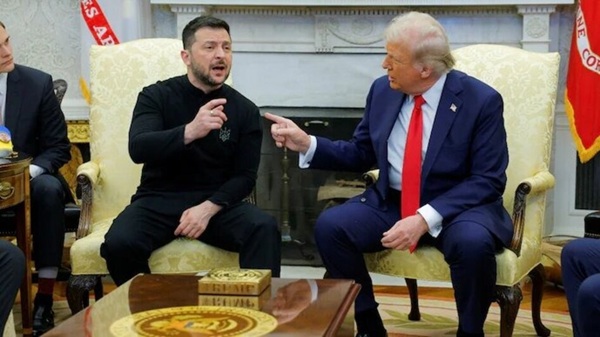


New Delhi. US President Donald Trump celebrated Diwali by lighting lamps at the White House. Addressing the Indian community, Trump said, “Happy Diwali to the people of India. I spoke with Prime Minister Narendra Modi on the phone. It was a wonderful conversation. We discussed trade and many things, but especially the world of trade. He is very interested in this topic.”
President Trump stated that the issue of regional peace also came up during the conversation. He said, “We discussed the need to avoid war between India and Pakistan some time ago. I think the trade issue involved allowed me to discuss this. Today, there is no war between India and Pakistan, and that is a very good thing.” He also reiterated that India will not purchase large quantities of Russian oil in the future.
No confirmation from India
India has not confirmed Trump’s latest claims. This is nothing new. A week ago, Trump made a similar claim: he spoke with Prime Minister Modi, in which Modi assured New Delhi that New Delhi would stop buying oil from Russia. Trump described this as a “major step” in his efforts to isolate Moscow over the Ukraine war.
However, India completely denied this statement at that time. The Ministry of External Affairs (MEA) categorically stated, “There was no phone call between the two leaders yesterday.”
Wishes for Diwali
In a statement issued from Washington, Donald Trump said, “Today, I extend my best wishes to all Americans celebrating Diwali, the festival of lights.”
He said that Diwali is not just a festival, but a symbol of the triumph of light over darkness. It always reminds us that good ultimately triumphs over evil.
Trump said that this is a time to bring family and friends together. “Diwali is a time when people light up their homes, celebrate together, and start life with new hope and energy.”
He said, “When millions of people light diyas and lanterns, we celebrate the fact that good always triumphs over evil. To every American celebrating Diwali, I wish this festival brings peace, prosperity, hope, and comfort to your lives.”
Up to 155% tariff on China
Responding to a question from a news agency, Trump said that tariffs of up to 155% will be imposed on China starting November 1. He said that such heavy tariffs will put pressure on China’s economy.
Trump said, “I want to have good relations with China, but the truth is, they were very strict with us for many years. Because our previous president wasn’t wise enough to protect American interests in business. This isn’t just a matter of trade, it’s a matter of national security.” I was able to do all this because of tariffs. Now hundreds of billions, even trillions, of dollars are coming into America. We will start paying off our debt with this.
A History of Trade Tensions
Donald Trump’s statement comes at a time when trade tensions between Washington and Delhi are continuing. In response to India’s purchase of Russian oil, Trump imposed an additional 25 percent tariff on Indian goods, bringing the total tariff rate on imports from India this year to nearly 50 percent.
Earlier in the day, Trump defended his tariff policy, claiming that it has not only strengthened the US economy but also prevented potential wars. He said, “I mentioned eight wars. Five of them were entirely based on trade and tariffs.”
Claim to prevent an India-Pakistan war
Trump claimed that his trade diplomacy intervention averted a major conflict. He said, “India and Pakistan were facing each other. Two nuclear powers, and serious nuclear ones. Seven planes had been shot down. They were ready to go, and I called them.”
He explained that he had warned both countries that a military conflict would affect their trade relations with the United States. According to Trump, “I said, ‘You go to war, and we won’t have a trade deal.’ They said, ‘What does one have to do with the other?’ I said, ‘A lot. You’re nuclear powers. If you do that, we won’t have a trade deal.'”
India has consistently denied US President Donald Trump’s claims of brokering a ceasefire between India and Pakistan. Indian officials have clarified that the ceasefire was reached through direct communication between the Directors General of Military Operations (DGMOs) of the two countries, not through any third-party intervention.
Share:










Indore (HO)
Bhopal
Jabalpur


©2026 Agnibaan , All Rights Reserved