

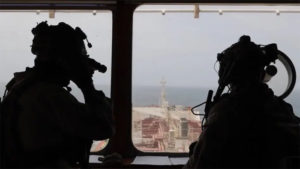
New Delhi: Although US airstrikes on Iran have temporarily ceased, tensions between the two countries remain high. The conflict has shifted from the skies to the sea, with the United States intensifying its naval blockade around the Strait of Hormuz, the Gulf of Oman, and the Arabian Sea to tighten pressure on Tehran.
The US Navy says it is closely monitoring all vessels suspected of heading toward Iran and is taking action against ships that violate the blockade. According to the US Central Command (CENTCOM), by July 25, at least 12 commercial vessels bound for Iran had been forced to change course. Two ships were disabled after ignoring repeated warnings, while two others were boarded and inspected by US forces.
One such operation took place in the Arabian Sea, where US personnel boarded the Comoros-flagged oil tanker M/T Charminar. After completing the inspection, the vessel was allowed to continue its journey. On July 24, US forces also intercepted and disabled the Mozambique-flagged tanker M/T Lavin in the Gulf of Oman, alleging that it attempted to sail toward Iran despite multiple warnings.
Trump Reviews Next Phase of Iran Strategy
While no fresh US airstrikes have been reported since July 24, military planning in Washington continues. US President Donald Trump held a high-level meeting with senior national security officials at the White House on July 24 to review the next phase of the Iran strategy. Reports suggest that expanding military operations, including possible ground action, was among the options discussed.
Diplomatic efforts are also underway. An Omani delegation reportedly visited Tehran to explore reopening the Strait of Hormuz, and shortly afterwards Trump announced a temporary pause in further airstrikes, saying talks between Washington and Tehran were continuing.
Iran Changes Its Response Strategy
Iran has also adjusted its military approach. Over the past 24 hours, Tehran reportedly targeted only a US military base in Bahrain. Earlier, Iranian strikes had also focused on US facilities in Kuwait and Jordan.
Security analysts believe Iran is now adopting a more calibrated response, limiting its attacks while attempting to maintain pressure on the United States without triggering a wider regional escalation. The evolving maritime standoff indicates that, despite the pause in bombing, the US-Iran confrontation remains far from over.
Share:













Indore (HO)
Bhopal
Jabalpur


©2026 Agnibaan , All Rights Reserved