
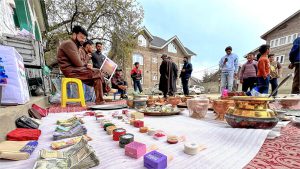
New Delhi: It has been nearly a month since the outbreak of conflict in West Asia. During this period, the volume of donations being collected for Iran within the Kashmir Valley has surged significantly. However, alongside this influx of aid, concerns among intelligence agencies are also mounting.
According to government estimates, a total of ₹17.91 crore has been collected for Iran in the Kashmir Valley so far. These funds are being contributed in fulfillment of religious obligations such as Zakat and Sadqa. Members of the Shia community account for 85 percent of the donors. The highest contribution—₹9.5 crore—has come from Budgam district alone.
In light of this massive surge in donations, the Iranian Embassy has issued a new bank account and a UPI ID. Consequently, the total amount is expected to rise further in the coming days.
Why Are Intelligence Agencies Concerned?
Most people are donating wholeheartedly and with genuine intent; there is no doubt about that. However, intelligence agencies warn that nearly half of these funds could potentially fall into the wrong hands.
The reason for this concern is that numerous intermediaries and suspicious organizations are collecting donations in cash. Many of these entities maintain neither proper financial records nor any form of accountability. Furthermore, in several instances, donations are being received in the form of gold, silver, copper utensils, and even livestock—assets that are extremely difficult to manage and account for. Intelligence sources have cautioned that these funds could be diverted to finance radical activities, separatist propaganda, or anti-India operations.
The Lesson of Sarjan Barkati
Intelligence officials have cited the case of Sarjan Barkati, a cleric from South Kashmir, as a cautionary example. During the violent unrest of 2016, he raised over ₹1.5 crore from the public through emotional appeals. Subsequent investigations revealed that these funds were utilized to amass personal wealth and to sustain a terrorist network. Several donors themselves came under the scanner during the investigation, and in some cases, their passports were even impounded. Officials warned, “People donate money for noble causes, but they often fail to verify whether those funds will actually be utilized for the intended purpose.”
The Iranian Network and Kashmiri Clerics
Intelligence reports also indicate that several Shia religious leaders in Kashmir already receive financial assistance from Iranian entities. These funds are reportedly distributed through Hakim Sajjad of Bagwanpora, Srinagar.
Furthermore, Iran has long sought to cultivate its influence in Kashmir—primarily by offering scholarships and educating Kashmiri youth in the seminaries of Qom and Mashhad. Upon their return, these young individuals serve as Imams and preachers, thereby influencing the local intellectual landscape.
This explains why, when news of Ayatollah Khamenei’s alleged assassination surfaced on March 1st, the ensuing protests in Kashmir featured pre-prepared Hezbollah flags. This was not a spontaneous outpouring of emotion; rather, it signaled the presence of an organized network.
Dos and Don’ts
The advice from intelligence officials is clear: deposit funds directly into the Iranian Embassy’s bank account. This offers a greater guarantee that the money will reach its intended destination. Avoid handing over cash to any local organization or intermediary—particularly those with no established track record. Several community leaders have also been urged to help raise public awareness regarding this matter.
Share:










Indore (HO)
Bhopal
Jabalpur


©2026 Agnibaan , All Rights Reserved