

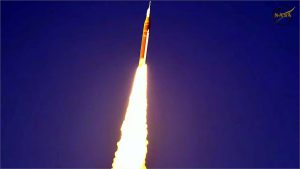
Washington. After nearly 54 years, humanity is once again setting its sights on the Moon. The U.S. space agency NASA’s first crewed mission, Artemis II, successfully launched from Florida at 4:05 AM on Thursday (Indian Standard Time). Aboard this mission are Christina Koch, Victor Glover, Reid Wiseman, and Jeremy Hansen, who were propelled into space atop an SLS rocket. This 10-day journey will carry the astronauts approximately 406,000 kilometers away from Earth—a distance considered to be the farthest human spaceflight ever undertaken.
As part of the Artemis II mission, the astronauts will travel close to the Moon but will not land on its surface. This is a test mission designed to validate the technologies and capabilities essential for future lunar expeditions. The entire mission is expected to conclude in approximately 10 days, after which the astronauts will return safely to Earth following their orbit around the Moon.
Prior to the launch, NASA took to social media to invite the public to witness this historic moment. The agency stated that this mission represents a significant stride toward establishing a human presence on the Moon and, eventually, on Mars.
The hatch is now closed.
The Artemis II astronauts are now strapped into their seats and ready for launch. pic.twitter.com/NWSjgklep9
— NASA (@NASA) April 1, 2026
Four Astronauts to Journey Around the Moon on a 10-Day Voyage
NASA’s Artemis II mission is a story that extends far beyond merely orbiting the Moon. It marks the first instance where the human body will undergo a true test within the environment of deep space. Stepping beyond the protective boundaries of Earth, the four astronauts will face the rigors of cosmic radiation and deep-space conditions, with every physiological change occurring within their bodies being meticulously recorded. Coming 50 years after the last lunar landing, this human voyage is not merely a historic event; it also serves as a pivotal scientific experiment paving the way for future long-duration space missions.
According to NASA, the Artemis II mission will carry the four astronauts on a journey around the Moon spanning approximately 10 days. For the first time since 1972, humans will venture beyond Earth’s magnetic field—a distance that could exceed that of any previous human spaceflight. This mission is part of the Artemis program series, which aims to establish a permanent human presence on the Moon. This undertaking will be of immense significance.
Analyzing Bodily Changes via Chip Technology
The most advanced experiment of this mission involves “Organ-on-a-Chip” technology. Cells derived from the blood of each astronaut will be cultured on a microchip. One chip will travel into space, while a counterpart remains on Earth. Following the mission, a comparative analysis will be conducted to assess the extent of changes in DNA damage, telomere length, and other biological markers. This marks the first time such an experiment is being conducted outside of Low Earth Orbit. The true significance of this technology will become apparent in the future, when NASA will be able to predict, in advance, the effects of deep-space travel on any potential astronaut’s body. In other words, it will be possible to assess the associated risks even before the spaceflight begins.
How Many Times Has the Artemis II Launch Been Postponed?
The launch dates for the Artemis II mission have recently undergone several adjustments. Originally, the mission was scheduled to launch in February 2026 (specifically between February 6 and 8). However, NASA was compelled to postpone the launch due to technical issues encountered during rocket fueling tests. Subsequently, NASA designated potential launch windows in March (specifically March 6–9 and March 11); however, the mission was unable to lift off on those dates.
Following rigorous testing and preparations, NASA is now poised to launch this historic mission on April 1, 2026. The launch is expected to take place on the evening of April 1 from the Kennedy Space Center in Florida. At the moment Artemis II lifts off, it will be early morning on April 2 in India. Meanwhile, if the launch on April 1 is not possible due to weather or any other technical reasons, NASA has several backup dates available within April itself—including April 3 to 6 and April 30. All in all, NASA is now aiming to send this mission into space in April 2026.
Share:













Indore (HO)
Bhopal
Jabalpur


©2026 Agnibaan , All Rights Reserved