
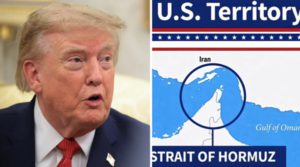
New Delhi: Tensions between the United States and Iran are escalating further after US President Donald Trump shared a map on Truth Social appearing to designate the strategically vital Strait of Hormuz as US territory.
The latest claim comes amid an increasingly bitter standoff between Washington and Tehran. Iran has maintained that it will not agree to reopen the Strait of Hormuz unless the United States changes its current policy toward the country.
Trump Repeats His Hormuz Claim
Trump’s latest post is not the first time he has made such a claim. On August 18, he shared a similar map suggesting that the Strait of Hormuz could soon be declared US territory. Earlier, on August 14, Trump had said during an event in Long Island that the United States would “very soon” make a similar declaration.
The repeated statements have added another dimension to the growing dispute over one of the world’s most strategically important waterways.
Iran Hits Back at Trump
Iranian officials have sharply rejected Trump’s claim. Mohsen Rezaei, Secretary of Iran’s Supreme National Security Council, mocked the US position, saying the distance between Washington’s failure to reopen the Strait and its claim of ownership was greater than the physical distance between the two.
Rezaei also referred to the possibility of a “post-American order” emerging in the Persian Gulf, signaling Tehran’s determination to challenge US influence in the region.
Washington Prepares Tougher Sanctions
Trump’s latest statement comes as the US prepares a new round of potentially severe economic sanctions against Iran. US Treasury Secretary Scott Bessent could announce some of the toughest sanctions ever imposed on Tehran.
Washington has also called on China to cooperate over Iranian oil exports. China is a major buyer of Iranian crude, meaning tougher US sanctions could put additional pressure on economic ties between Beijing and Tehran.
Iran Rejects US ‘Secondary Sanctions’
Iranian Foreign Ministry spokesman Esmaeil Baghaei has criticized the proposed sanctions, arguing that Washington is attempting to extend its authority beyond US borders.
Baghaei said secondary sanctions have no basis in international law. Rezaei, meanwhile, warned neighboring countries against participating in the US economic campaign, saying Tehran would consider countries joining the campaign to be part of an economic war against Iran.
Trump Warns Countries Helping Iran
The Trump administration has also warned countries, businesses and other entities against providing Iran with economic assistance or facilitating trade with Tehran.
Washington is seeking to further isolate Iran from the global financial system, with particular focus on the country’s oil exports, financial transactions and companies involved in supporting its economy.
Tehran Shows No Sign of Backing Down
Iran has made it clear that it is not prepared to reopen the Strait of Hormuz under the current circumstances. Tehran says any agreement on reopening the waterway would require Washington to change its approach toward Iran.
At the same time, Iranian President Masoud Pezeshkian has indicated that diplomacy remains an option. He has called for efforts to end the confrontation while ensuring that Iran maintains its strength and dignity.
Why the Strait of Hormuz Matters
The Strait of Hormuz connects the Persian Gulf with the Gulf of Oman and the Arabian Sea and is one of the world’s most important energy corridors. A prolonged disruption or escalation around the waterway could affect international oil supplies, potentially driving up crude prices and creating wider economic consequences.
For now, Trump’s latest claim and Iran’s strong response point to a further escalation in an already tense US-Iran confrontation, with the Strait of Hormuz emerging as a key flashpoint.
Share:













Indore (HO)
Bhopal
Jabalpur


©2026 Agnibaan , All Rights Reserved