
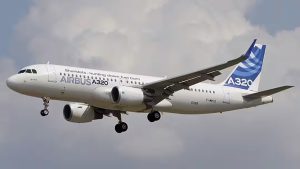
New Delhi. Airbus A320 family aircraft worldwide are being grounded for extensive software and hardware upgrades due to a serious technical defect directly related to aircraft safety. A recent incident involving an Airbus A320 flight has alarmed the entire aviation sector.
What happened to the Airbus A320? How did the danger arise?
The problem occurred on a private airline’s A320 flight from Cancun to New York when the plane suddenly pitched downward at an altitude of thousands of feet. The pilot did not give any such command, but the cabin experienced a violent jolt, throwing passengers from their seats. Several people were injured, and the flight had to be diverted to Tampa in an emergency. An investigation determined that the malfunction occurred during the switching of the ELAC flight control computer, which read incorrect pitch data.
On November 28th, EASA issued an Emergency Airworthiness Directive, ordering the immediate removal of the old ELAC computer (model B L104) and its replacement with a new, safer model (B L103+). Aircraft equipped with the old system will not be allowed to fly. Only limited ferry flights will be permitted if necessary.
Major Impact in India
This has had a major impact in India, as the country is the world’s largest operator of the A320. Approximately 200 IndiGo aircraft and 100–125 Air India aircraft are currently grounded or in limited operation due to upgrades and inspections. Air India has warned passengers that this could lead to flight delays and disruptions to schedules.
What did the joint investigation by Airbus and EASA find?
A joint investigation by Airbus and EASA found that increased solar radiation at high altitudes caused a “bit-flip,” or data corruption, in the ELAC computer chip. This caused the computer to misread the signals, and the plane began to tilt downward despite being in autopilot mode.
The Airbus A320 is considered one of the world’s safest aircraft.
The Airbus A320 is considered one of the world’s safest and most advanced fly-by-wire aircraft, but this incident has exposed the vulnerability of its most critical component, the ELAC computer. Globally, approximately 6,000 aircraft are undergoing this upgrade process. While the new A320neo will require only a 30-minute software update, older models can take 2–3 days to replace both hardware and software.
Share:









Indore (HO)
Bhopal
Jabalpur


©2026 Agnibaan , All Rights Reserved