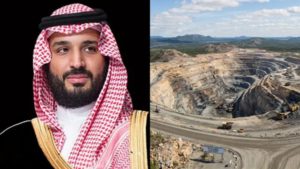
New Delhi: Saudi Arabia has reported a major mineral exploration development in the Medina region, estimating approximately 110 million tonnes of ore resources at the Jabal Sayid project. Saudi Energy Minister Prince Abdulaziz bin Salman said geological surveys and exploration have indicated the presence of uranium as well as significant concentrations of heavy rare earth elements.
However, the figure of 110 million tonnes should not be interpreted as 110 million tonnes of pure uranium. It represents the total estimated ore resource, within which uranium and rare earth elements have been identified. The precise quantities, grades and commercially recoverable volumes will require further exploration, testing and feasibility studies.
Jabal Sayid Survey Reveals Major Mineral Potential
According to Arab News, the 110-million-tonne estimate follows geological studies and exploration activities carried out at the Jabal Sayid project.
The reported presence of heavy rare earth elements alongside uranium has attracted particular attention. Rare earths are increasingly important to modern industries, while uranium could become strategically significant as Saudi Arabia develops its civil nuclear energy ambitions.
If subsequent studies establish that these resources can be extracted economically on a large scale, the discovery could mark an important milestone in Saudi Arabia’s efforts to expand its mining and industrial base.
Why the Medina Region Matters
The discovery has drawn additional attention because of Medina’s exceptional religious and historical importance. Medina is one of Islam’s holiest cities and played a central role in the development of the early Islamic community following Prophet Muhammad’s migration from Mecca in 622 AD.
The reported mineral potential therefore carries significance beyond the mining sector, particularly as Saudi Arabia seeks to diversify its economy and strengthen its position in strategic industries.
The development also comes amid continuing international attention on energy security and nuclear programs in the Middle East. Saudi Arabia has been pursuing greater capabilities in civilian nuclear energy, while Iran’s nuclear program remains a major focus of regional and international debate.
A Potential Boost for Vision 2030
The reported mineral resources fit into Saudi Arabia’s broader Vision 2030 strategy, which aims to reduce the country’s dependence on oil and build new sources of economic growth.
Although Saudi Arabia remains one of the world’s leading oil producers, the kingdom is investing heavily in sectors including mining, renewable energy, advanced manufacturing and civil nuclear power.
Domestic uranium resources, if confirmed and commercially viable, could eventually become relevant to Saudi Arabia’s long-term nuclear-energy plans. Meanwhile, rare earth resources could support ambitions to establish stronger domestic supply chains for high-tech and advanced industrial products.
Uranium Ore Is Not the Same as Nuclear Fuel
The reported uranium presence should also be understood in the proper context.
Uranium occurring naturally in mineral ore is not immediately usable as nuclear fuel. Extracting uranium requires mining and processing, followed by additional stages such as conversion and, where required, enrichment before suitable nuclear fuel can be produced.
Therefore, the reported discovery does not mean Saudi Arabia has suddenly obtained a ready supply of nuclear fuel. Its eventual strategic value will depend on the quantity and grade of uranium present, the economics of extraction and processing, and Saudi Arabia’s future nuclear policies.
Rare Earth Elements Could Be Equally Important
The rare earth component of the reported discovery could prove particularly significant for Saudi Arabia’s industrial ambitions.
Heavy rare earth elements are used in a variety of advanced technologies, including electronics, electric vehicles, renewable-energy systems, specialized magnets and defense applications.
As countries around the world seek to secure supplies of critical minerals, developing domestic sources could give Saudi Arabia an opportunity to strengthen its position in global high-tech and industrial supply chains.
What Happens Next?
For now, the 110 million tonnes figure represents an estimated total ore resource, rather than the amount of uranium or rare earth elements that can ultimately be recovered.
More detailed geological surveys, laboratory testing, resource evaluation and commercial feasibility studies will be needed to determine the actual grades and economically recoverable quantities.
If those studies confirm substantial and commercially viable deposits, the Jabal Sayid project could become an important part of Saudi Arabia’s ambitions to expand its mining sector, reduce its dependence on oil and develop new capabilities in energy and high technology.
Share:











Indore (HO)
Bhopal
Jabalpur


©2026 Agnibaan , All Rights Reserved