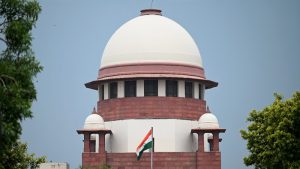
New Delhi: The Supreme Court has declined to intervene in a plea seeking a separate drop-down list of Other Backward Class castes in the online census form, observing that the issue falls within the domain of government policy.
A bench comprising Justices Surya Kant, Joymalya Bagchi and V. Mohana disposed of the petition filed by the OBC Federation of India on Wednesday. However, the court granted the petitioners the liberty to submit their representation before the Registrar General and Census Commissioner of India.
The petition sought the inclusion of a dedicated drop-down menu listing OBC castes in the online census form to ensure their systematic and accurate recording.
Petition Seeks Dedicated Drop-Down Menu for OBC Castes
Advocate Anjani Iyengar, appearing for the OBC Federation of India, told the court that the petitioners belong to backward classes and had approached the authorities seeking changes to the online census form.
According to the petition, Column 10 of the census schedule seeks information relating to Scheduled Castes, Scheduled Tribes and caste identification. While provisions exist for recording SC and ST details, respondents belonging to other caste categories are required to enter their caste names manually in an open-text field.
The petitioners argued that this arrangement could make the systematic identification and compilation of OBC caste data more difficult.
Petitioners Cite 2011 Census Format
The Federation also referred to the 2011 Census, arguing that a dedicated drop-down menu for OBC castes would help ensure more organised and consistent data collection.
The petitioners maintained that providing a predefined list would make it easier for respondents to identify and record their respective castes rather than relying entirely on manual entries.
Supreme Court Allows Representation to Census Authorities
During the hearing, the bench observed that the demand involves a policy decision that falls within the government’s purview. The court therefore disposed of the petition without directing the government to introduce the proposed changes.
However, the petitioners remain free to approach the Registrar General and Census Commissioner of India with their concerns. The authorities will have to consider the representation in accordance with the applicable process.
The matter has brought renewed attention to the method of collecting caste-related information in the census and the demand for a more structured system to record OBC communities.
Share:






Indore (HO)
Bhopal
Jabalpur


©2026 Agnibaan , All Rights Reserved