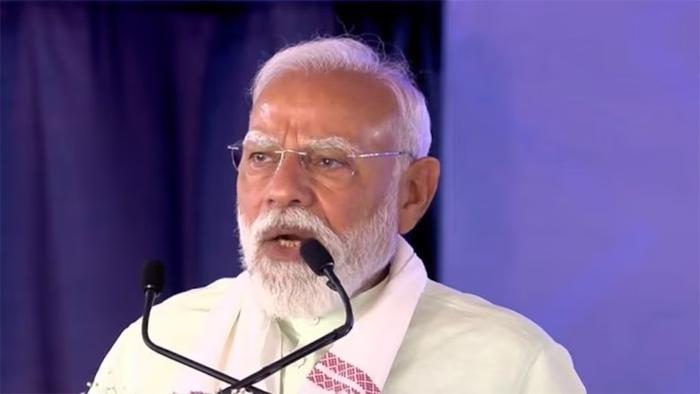


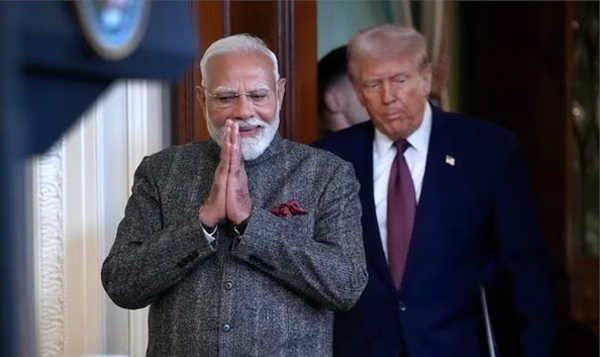
Nicosia. Prime Minister Narendra Modi said on Monday that he and Cyprus President Nikos Christodoulides ‘expressed concern’ over the ongoing conflicts in West Asia and Europe and both of them believe that ‘this is not the era of war.’ During their visit, Modi and Christodoulides also saw the mountains near Nicosia from the roof of a building, which are under the control of Turkiye. This would have given a message to Turkiye, which openly supported Islamabad during the recent India-Pakistan conflict.
Modi said this after detailed discussions on all aspects of bilateral relations with Christodoulides. The two leaders discussed cooperation in areas such as defense, security, trade, technology, healthcare, renewable energy and climate justice. They also discussed regional and global issues, including conflicts in West Asia and Europe.
The Prime Minister’s visit to Cyprus is significant in view of the island nation’s strained relations with Turkey. This is his first foreign visit after India launched Operation Sindoor in May. Under Operation Sindoor, launched in response to the Pahalgam terror attack, terrorist infrastructure in Pakistan and Pakistan-occupied Kashmir (PoK) was destroyed.
India expressed gratitude to Cyprus
Modi, the first Indian Prime Minister to visit Cyprus in more than two decades, while addressing a joint press conference with Christodoulides after their talks, said, “We are grateful for Cyprus’ support in India’s fight against cross-border terrorism.”
The joint statement issued after the talks said that Cyprus and India unequivocally condemn international and cross-border terrorism as well as violent extremism and reaffirm their shared commitment to combat hybrid threats that undermine peace and stability. Noting a “zero tolerance” towards terrorism, they rejected any justification for such acts under any circumstances and stressed that those responsible for the attacks must be held “accountable”.
Without naming any country, Modi said, “We both expressed concern over the ongoing conflicts in West Asia and Europe. Their negative impact is not limited to those regions alone. We both believe that this is not the era of war. Finding solutions through dialogue and restoring stability is what humanity demands.” “We have a historic friendship and trust in our relations,” the Cyprus President said.
He recalled the April 22 Pahalgam terror attack and said Cyprus stands in “full solidarity” with India. He said Cyprus stands with India in the fight against terrorism.
Turkiye issue raised
President Christodoulides also said that the two sides also discussed the Cyprus issue and said that Cyprus wants to end Turkiye’s ‘illegal occupation’ of the disputed northern region. He said, ‘We express our gratitude on behalf of the Republic of Cyprus for the support of India and its people.’ He referred to India’s contribution to the UN peacekeeping force in Cyprus.
India gave full support to Cyprus
The joint statement said that Cyprus and India ‘expressed their firm commitment to restart the efforts supported by the United Nations to find a comprehensive and lasting solution to the Cyprus problem on the basis of a bi-zonal, bi-communal union with political equality, in accordance with the agreed framework of the United Nations and the resolutions of the United Nations Security Council.’
It said, ‘India reiterated its continued support for the independence, sovereignty, territorial integrity and unity of the Republic of Cyprus. In this regard, both sides emphasized the need to avoid unilateral actions in order to create a favorable environment for the resumption of meaningful dialogue.’ The relationship between Cyprus, an island nation located in the eastern Mediterranean, and neighbouring Turkey has been uneasy.
When Turkey occupied part of Cyprus
According to the website of the UN Peacekeeping Force in Cyprus, the Turkey government, citing the 1960 Treaty of Guarantee, launched a massive military operation on the northern coast of Cyprus, which eventually resulted in the occupation of the main Turkey Cyprus enclave north of Nicosia. In 1974, India had taken a firm stand in support of the sovereignty, unity and territorial integrity of the Republic of Cyprus.
In his press statement, Modi said his visit is a ‘golden opportunity’ to write a new chapter in India-Cyprus bilateral relations. Modi said there are many similarities in Cyprus’ ‘Vision 2035’ and the vision of a developed India 2047. “A new momentum to further deepen India-Cyprus relations,” External Affairs Ministry spokesperson Randhir Jaiswal wrote in a post on ‘X’ regarding the visit.
He said that during the delegation-level talks, the two leaders discussed ways to deepen cooperation in traditional areas of trade and investment, counter-terrorism and culture as well as new areas of defense industry, connectivity, innovation, tourism and mobility. Modi said Cyprus is also a favourite tourist destination for Indians and efforts will be made for direct flights between the two countries.
He said, “We also discussed how to strengthen cultural ties. It is heartening to see the popularity of yoga and Ayurveda increasing in Cyprus. Tourism is another area where there is a lot of potential. We also discussed ways to improve connectivity.’
India-West Asia-Europe Economic Corridor (IMEC) and India-EU relations also figured during their talks. Prime Minister Modi also invited the President of Cyprus to visit India. Modi thanked the President for reiterating Cyprus’ support for India’s permanent membership in a reformed United Nations Security Council.
Share:









Indore (HO)
Bhopal
Jabalpur


©2026 Agnibaan , All Rights Reserved