
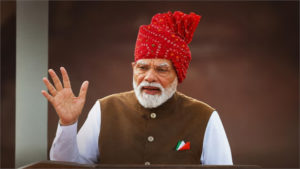
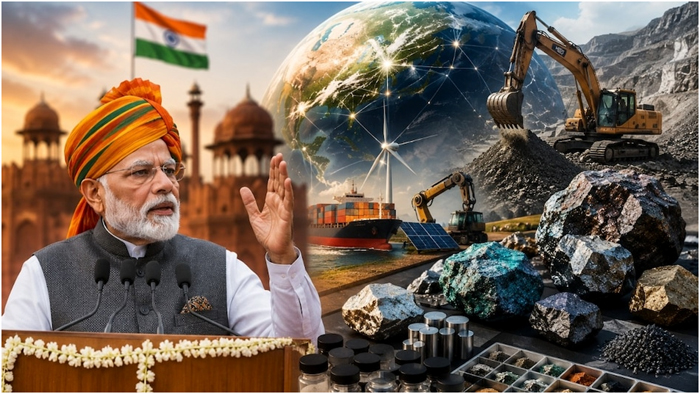
New Delhi: Prime Minister Narendra Modi, addressing the nation from the ramparts of the Red Fort on Independence Day, unveiled an ambitious roadmap for India’s next phase of development, while presenting a detailed account of the country’s transformation over the past 12 years.
Emphasising the importance of setting ambitious goals, PM Modi said that when a nation’s dreams and resolutions are high, its capabilities and efforts also rise to meet them. He reiterated the national commitment to building a ‘Viksit Bharat’ by 2047, when India completes 100 years of independence.
The Prime Minister said the resolve of 1.4 billion Indians to achieve this goal reflects the country’s growing confidence and determination. He also paid tribute to citizens across social, economic and geographical backgrounds whose efforts, he said, have helped take India to new heights.
PM Modi’s 12-Year Report Card: Defence, Manufacturing and Digital Growth
Highlighting the progress made over the past 12 years, PM Modi pointed to major growth across several sectors.
According to the figures cited by the Prime Minister:
He said the government has simultaneously focused on improving basic amenities and public infrastructure, including tap-water connections, LPG access, housing and sanitation. The Prime Minister also highlighted the repeal of hundreds of outdated laws, arguing that regulations created in the previous century must be replaced where necessary to meet the requirements of the 21st century.
Seven ‘Streams of Strength’ for India’s Next Phase
Looking ahead, PM Modi outlined seven major areas that he described as ‘Shakti ki Sapt Dhara’, or seven streams of strength.
These include:
1. Manufacturing
2. Agriculture and food processing
3. Technology and innovation
4. Gati-Shakti and modern infrastructure
5. Defence strength
6. Green and blue economy
7. India’s soft power
The Prime Minister said these sectors will be crucial in driving India’s growth and strengthening its global position over the coming years.
Big Push for Defence Self-Reliance
PM Modi stressed the need to make India increasingly self-reliant in defence technology. He highlighted drones and counter-drone systems, hypersonic defence technology and cybersecurity as areas where India needs to build capabilities and take a leading role. He also emphasised the potential of India’s young talent in developing advanced technologies for both national security and global applications. The Prime Minister also pointed to progress in fast-breeder nuclear technology, describing it as an important milestone in India’s pursuit of greater nuclear fuel self-reliance.
Semiconductors: India Moves from Debate to Production
Highlighting the strategic importance of chips, PM Modi said semiconductors are now essential to virtually every modern electronic device.
He said India had discussed semiconductor technology for decades but had struggled to translate those discussions into large-scale production. The situation, he said, has now changed, with semiconductor plants established in the country and production underway.
According to the Prime Minister, three semiconductor plants are already operational, while additional facilities are expected to come up over the next seven to eight years.
Critical Minerals and Energy Security Take Centre Stage
PM Modi also underlined the importance of critical minerals for modern technologies, including semiconductors, artificial intelligence and data centres. India has announced a Critical Minerals Corridor and is pursuing agreements with several countries to secure reliable supplies.
The Prime Minister stressed that energy security is equally important because emerging technologies require enormous amounts of electricity. He also highlighted India’s efforts to expand exploration for offshore resources, noting the shift from restrictions on large portions of coastal areas towards greater exploration and resource development.
PM Surya Ghar: 50 Lakh Homes Cross Solar Milestone
Highlighting the PM Surya Ghar: Muft Bijli Yojana, PM Modi said more than 50 lakh households have been equipped with rooftop solar systems.
He said the initiative is helping thousands of families reduce their electricity bills to zero, while some households are also earning income by selling surplus power generated by their solar systems.
The government is providing financial assistance of up to ₹80,000 per family under the scheme, he said.
Railway Electrification: 90 Years vs One Decade
Using railway electrification as an example of India’s accelerated development, PM Modi said electrification began in the country in 1925, but only around 30% of the railway network had been electrified over the following nine decades.
He said India subsequently achieved 100% railway electrification within about a decade, highlighting the speed of infrastructure development in recent years.
Piped Gas Network Expands from 70 to 700 Cities
The Prime Minister also highlighted the expansion of piped gas infrastructure.
According to him, around 12 years ago, piped gas distribution was available in only about 70 cities. Today, the network has expanded to around 700 cities.
The number of households receiving piped gas has also increased from approximately 20–22 lakh to 1.75 crore households, PM Modi said.
Solar Power Capacity Jumps from 2 GW to 160 GW
India’s renewable energy expansion was another key highlight of the address.
PM Modi said that around 12 years ago, India’s solar power capacity stood at just 2 GW, whereas it has now reached approximately 160 GW.
He also reiterated the need to accelerate alternative energy development and reduce dependence on conventional energy sources.
‘Crisis Could Not Stop India’s Momentum’
Reflecting on the challenges faced by the country in recent years, PM Modi said India’s development momentum continued despite major global crises.
He referred to initiatives such as ‘Samudra Manthan’, aimed at exploring new energy and resource opportunities, and said the government has recently allocated ₹85,000 crore to accelerate related work.
The Prime Minister concluded with a message of confidence, stressing that India’s biggest limitation is not a shortage of resources but the limitations imposed by its own thinking.
With a long-term target of Viksit Bharat by 2047 and a focused agenda for the next five years, the Red Fort address laid out a vision centred on self-reliance, technology, energy security, manufacturing, defence, innovation and global competitiveness.
Share:











Indore (HO)
Bhopal
Jabalpur


©2026 Agnibaan , All Rights Reserved