

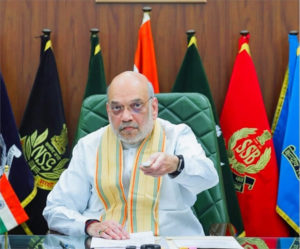
New Delhi: Union Home Minister Amit Shah has returned to North Bengal for the second time in about a month, putting the region’s sensitive security landscape under renewed focus. His three-day visit includes a detailed review of border security, assessment of key border areas and meetings with personnel of the Sashastra Seema Bal (SSB).
The Centre’s attention is particularly focused on the strategically crucial Siliguri Corridor, along with India’s international borders with Nepal, Bhutan and Bangladesh.
After landing at Bagdogra, Amit Shah travelled to Sukna. On August 21, programmes related to border-security projects are scheduled at the SSB Frontier Headquarters. A high-level meeting with senior officials from security agencies and the state administration is also proposed for August 22.
Why Is the Siliguri Corridor So Crucial?
Often described as the “Chicken’s Neck,” the Siliguri Corridor is the narrow land link connecting the rest of India with the Northeast.
Its strategic importance is heightened by its proximity to the borders of Nepal, Bhutan and Bangladesh. Any serious security disruption in this region could have consequences far beyond West Bengal, potentially affecting the military, civilian and economic connectivity of the entire Northeast.
Security Focus Goes Beyond Infiltration
Security experts say the Centre is increasingly adopting a multi-layered approach to securing India’s eastern frontier.
The objective is not limited to preventing illegal infiltration. Agencies are also monitoring smuggling, arms and narcotics trafficking, human trafficking, cross-border crime and unusual activities in sensitive border areas.
Eastern Border Security in Numbers
– 3 international borders: Nepal, Bhutan and Bangladesh
– 8 Northeastern states: Their connectivity with the rest of India depends heavily on the Siliguri Corridor
– 1,647.696 km: Fencing erected along the India-Bangladesh border
The broader strategy combines border fencing, roads and border outposts with technical surveillance, intelligence sharing and rapid coordination between central and state agencies.
The Ministry of Home Affairs’ border-management framework brings these physical and technological security measures together to strengthen surveillance and response capabilities along the country’s vulnerable frontiers.
Share:













Indore (HO)
Bhopal
Jabalpur


©2026 Agnibaan , All Rights Reserved