
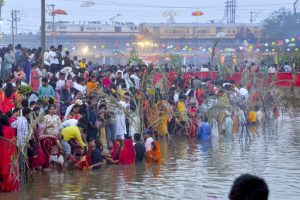
New Delhi. The four-day-long festival of Chhath—a grand celebration of public faith—concluded on Monday morning. As the darkness faded, crowds of devotees began gathering at riverbanks and water bodies across the country. In some places, those observing the fast stood with folded hands by the banks of the Ganges, awaiting the sunrise, while elsewhere, the air resonated with devotional songs dedicated to Chhathi Maiya near ponds and makeshift ghats. As the first rays of the sun appeared, the devotees offered arghya (ritual offerings) to the Sun God. Their ceremonial trays were laden with fruits, traditional prasad, and thekua (a signature Chhath delicacy). With this offering to the rising sun, the Chhath festival reached its conclusion. Following this, the devotees broke their rigorous 36-hour nirjala (waterless) fast. From early morning, the riverbanks were filled with an atmosphere of deep devotion and jubilation.
The vibrancy of Chhath Puja was evident everywhere—from Delhi to Bihar, and from Uttar Pradesh to Jharkhand. Devotees, both men and women, arrived at the riverbanks well before dawn, carrying their ritual offerings. Bamboo baskets (daure) were filled with fruits, thekua, and other traditional delicacies. Family members also joined in the rituals, praying to Chhathi Maiya and the Sun God for the well-being and prosperity of their families, as well as for the long lives of their children. Many riverbanks were beautifully decorated; some caught the eye with elaborate lighting and ornaments, while others hosted the rituals amidst the singing of traditional folk songs. Once the nirjala fast was broken, prasad was distributed in homes, and people exchanged warm wishes for the festival.
Crowds of devotees gather at riverbanks across Delhi-NCR
In the national capital, Delhi, devotees began arriving as early as the morning at the ghats along the Yamuna River and at various other designated worship sites across the city. At Kalindi Kunj Ghat, a large number of devotees offered arghya (oblations) to the rising sun. A special event also took place at the Kalka Ji DDA Flats Park in Greater Kailash to mark the conclusion of Chhath Puja. In Ghaziabad, the decoration of the ghats (riverfront steps) and a laser light display served as the main attractions. To facilitate the movement of devotees, the Delhi Metro began its services at 4:30 AM on Monday—earlier than the usual 6:00 AM start time. During these early hours, trains operated at 15-minute intervals across all lines.
*Devotion on display from the banks of the Ganges to Suryakund in Bihar*
In Bihar, a state synonymous with the Chhath festival, the ghats were bustling with activity from early morning. In Patna, a large number of devotees offered prayers along the banks of the Ganges. A crowd of worshippers also gathered at the ancient Suryakund in Gaya. Chhath Puja was celebrated across several districts, including Muzaffarpur, Samastipur, Madhepura, and Rohtas. In Samastipur, the mother of cricketer Vaibhav Suryavanshi also offered arghya to the rising sun. A ghat decorated with traditional Mithila paintings drew particular attention. In the Muzaffarpur Central Jail, 98 inmates also observed the Chhath tradition by offering arghya to the sun.
*Festive fervor across the *ghats from Varanasi to Ayodhya**
There was great enthusiasm for Chhath Puja in Uttar Pradesh as well. A large number of devotees gathered at the ghats along the Ganges in Varanasi. In Ayodhya, devotees offered arghya to the rising sun along the banks of the Saryu River. Women in Saharanpur also performed the rituals. In Haridwar, Uttarakhand, people who had migrated from Bihar and the Purvanchal region celebrated the festival with deep devotion. In Joshimath, the enthusiasm of the devotees remained undiminished despite the cold weather and rain. At Gandhi Maidan, people performed the rituals in the traditional manner. Beyond these locations, devotees in Udaipur and Pali (Rajasthan), as well as in Jalna (Maharashtra), also offered arghya to the Sun God to mark the conclusion of Chhath Puja. The four-day grand festival began with ‘Nahay-Khay’
Chhath Puja commenced on November 13 with ‘Nahay-Khay’. On the second day, November 14, the devotees observed ‘Kharna’. This was followed by a rigorous, waterless fast (nirjala upvas) lasting approximately 36 hours. On Sunday evening, the first ‘arghya’ (offering) was presented to the setting sun. The fast concluded on Monday morning with the second ‘arghya’ offered to the rising sun. Following this, the devotees broke their fast (‘paran’) and partook of the ‘prasad’.
In Chhath, the worship of the Sun God (Surya Dev) and Chhathi Maiya holds special significance. By adhering to strict rituals, devotees pray for the well-being of their families and the good health of their children. This festival is also rooted in the tradition of expressing gratitude toward nature, while emphasizing cleanliness and discipline. Traditional offerings, including ‘thekua’, are a hallmark of this festival.
Share:








Indore (HO)
Bhopal
Jabalpur


©2026 Agnibaan , All Rights Reserved