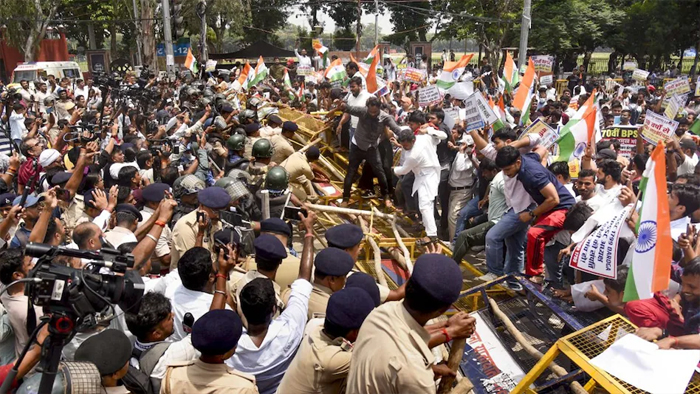

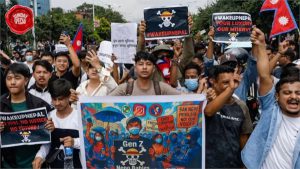
Kathmandu. A massive public uprising has erupted in Nepal against the policy decisions of the Balen Shah government. The echoes of protest can be heard reverberating from the streets of Kathmandu all the way to Singha Durbar—the seat of power. The most striking manifestation of this public outrage was witnessed when thousands of school students took to the streets to protest, still clad in their school uniforms. Student organizations have accused the government of adopting a repressive stance—prioritizing suppression over dialogue—and of attempting to dismantle student unions.
Furthermore, the decision to impose a mandatory customs duty on goods worth over 100 rupees brought in from India has sparked intense anger among residents of the border regions. Protesters argue that this policy places an unnecessary economic burden on the general public.
Another focal point of the protests is Home Minister Sudan Gurung; demands for his resignation have intensified amidst allegations regarding his illicit assets and suspicious business dealings. Political parties and civil society groups allege that the government is imposing anti-people policies upon the populace.
Amidst the ongoing protests, serious allegations of corruption have been leveled against Home Minister Sudan Gurung. According to documents published in the Nepali media, Gurung is accused of amassing assets disproportionate to his known sources of income and of engaging in suspicious business activities within the stock market in collusion with intermediaries. It is alleged that he conducted financial transactions with Deepak Bhatt—who is currently incarcerated in connection with a money laundering case—and purchased shares worth over 5 million rupees across several companies. Additionally, evidence has surfaced indicating that funds received by his INGO (International Non-Governmental Organization), ‘Hami Nepali’ (We Nepalis), were transferred into his personal bank account; these revelations have significantly intensified the pressure for his immediate resignation.
The most impactful aspect of this movement is the participation of school students. Large numbers of students, holding placards in their hands, are chanting slogans in protest against the government’s decisions. The students assert that the government is attempting to stifle the voices of student organizations, a move that has fueled widespread discontent within the education sector. This protest is no longer confined to the political sphere; it has evolved into a social movement in which the youth perceive the government’s policies as a threat to their future.
Trade and Customs Duty Tensions with India
The Government of Nepal has imposed customs duties even on minor goods imported from India, a move that is disrupting daily life. Residents of border regions—who rely on India to meet their daily necessities—are demanding a reversal of this decision. According to the protesters, this move by the Balen administration constitutes a direct assault on trade relations with India as well as on the pockets of ordinary citizens.
Share:










Indore (HO)
Bhopal
Jabalpur


©2026 Agnibaan , All Rights Reserved