
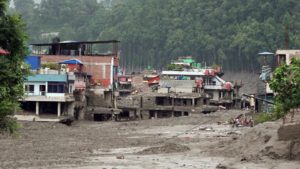
Kathmandu: Nepal is grappling with one of its worst flood disasters, with the death toll climbing to 587 and around 2,500 people still missing. The catastrophe has also raised serious concerns for Indian nationals, with authorities yet to establish contact with approximately 320 Indians and 100 people of Indian origin.
There is some relief amid the crisis. Contact has been established with around 400 Indians in Tibet, who have been reported safe. Meanwhile, 96 Indians stranded near the border have reached Nepal, while India has sent two consignments of relief material to support ongoing rescue and relief operations.
Fresh Flood Threat Looms Over Nepal
Rescue operations remain underway across the mountainous regions, but authorities are facing major challenges due to destroyed roads and bridges. The situation has become more precarious with reports of rising water levels near the Bhote Koshi River.
However, according to the latest update available at 6:30 AM on Saturday, water flow in both the Bhote Koshi and Trishuli rivers remained normal, with no significant or sudden rise reported so far.
The disaster originated in the high-altitude mountainous region. Preliminary findings indicate that a glacier collapse may have triggered a massive landslide of ice, rocks and debris, which entered the Lende River and temporarily blocked its flow. When the natural barrier eventually broke, a powerful surge of water, mud, rocks and debris swept downstream, devastating areas along the Bhote Koshi and Trishuli river systems.
Numerous settlements, roads, bridges and hydropower projects have been damaged or destroyed.
90,000 People Affected, Hydropower Workers Among Missing
According to the Nepal Red Cross, more than 90,000 people have been affected by the disaster.
The floods have also severely impacted hydropower projects. Around 933 employees linked to 13 hydropower projects were reported missing, although 254 have since been rescued. Several workers are feared trapped inside tunnels.
The situation is particularly alarming at the Upper Trishuli-1 hydropower project, where 576 employees remain unaccounted for.
Temporary Lake Raises Alarm of Another Disaster
A new threat has emerged upstream, where debris has obstructed the river and created a temporary lake. Authorities are closely monitoring the developing water body through satellite imagery.
Chinese officials estimate that around 2 million cubic metres of water has already accumulated, with another 3 million cubic metres potentially flowing into the lake over the next three days.
Authorities fear that if the natural debris barrier collapses under increasing water pressure, a sudden release could trigger another devastating flood downstream.
River Levels Currently Normal, But Danger Not Over
The Flood Forecasting Division reported that the Trishuli River, including areas around Rasuwa’s Bhote Koshi and Nuwakot, was flowing normally as of 6:30 AM Saturday.
Hydrologist Prabhakar Yadav said there had been no rapid rise in water levels so far. However, authorities continue to monitor the upstream situation closely, particularly the temporary lake and accumulated debris.
The National Disaster Management Authority has warned that the danger cannot yet be considered over. Residents living near the Bhote Koshi and Trishuli rivers, travelers and rescue personnel have been advised to remain vigilant.
Tibet Also Hit by Massive Flooding
The disaster has also caused extensive destruction across the border in China’s Tibet region. Five people have reportedly died and around 558 remain missing in Gyirong County, including approximately 260 foreign nationals.
Floodwaters have damaged villages, roads, bridges, power infrastructure and communication networks. The Kathmandu-Lhasa route has also been affected.
320 Indians Still Missing From Contact
The Indian Ministry of External Affairs has provided a major update on Indians affected by the disaster.
According to the latest information, contact has not yet been established with 320 Indian nationals and 100 people of Indian origin. Around 100 of those unaccounted for are believed to be stranded at the Trishuli Hydropower Project.
At the same time, contact has been established with around 400 Indians in Tibet, who are safe. Another 96 Indians stranded near the border have reached Nepal.
India has also sent two consignments of relief supplies to assist Nepal in its ongoing humanitarian response.
7,451 Personnel Involved in Rescue Operations
The destruction of more than 36 bridges has cut off several villages, making it difficult to transport food, medicines and other essential supplies.
Nepal has sought assistance from India and China to construct 42 Bailey bridges to restore connectivity.
As many as 7,451 security personnel, including 2,391 army personnel, are currently engaged in rescue and relief operations. Teams continue to search through debris and damaged infrastructure for survivors and missing people.
Although river conditions are currently stable, authorities remain on high alert because of the temporary lake and unstable debris upstream. Any breach could unleash another sudden surge of water into downstream areas.
The devastating floods have left thousands of families waiting for news of their loved ones. Rescue teams continue their search amid extremely difficult terrain, while authorities work to restore connectivity and deliver essential supplies.
Our deepest condolences go out to the families who have lost loved ones. We hope for the safe recovery of those still missing and the safety of everyone involved in the rescue and relief operations.
Share:









Indore (HO)
Bhopal
Jabalpur


©2026 Agnibaan , All Rights Reserved