
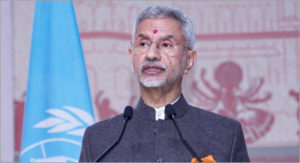
New Delhi: External Affairs Minister S. Jaishankar has offered a wide-ranging assessment of India’s foreign policy, highlighting the challenges of managing relations with the United States, the importance of maintaining peace along the Chinese border, and India’s efforts to strengthen trade ties with Europe.
Speaking at the Bloomberg New Economy Forum in Delhi, Jaishankar discussed the changing global order and its implications for India’s relationships with major powers. He also addressed the India-US trade deal, Chinese investment, Russia’s growing proximity to China, and the need for responsible regulation of artificial intelligence (AI).
‘Managing Relations with the US Is Not Easy’
Jaishankar said that dealing with the United States has become increasingly complex, not just for India but for countries across the world. He noted that Washington’s approach to international relationships and global engagement has evolved, prompting nations to reassess their partnerships and strategic priorities.
Recalling global developments such as Brexit, Donald Trump’s election and growing opposition to globalisation, Jaishankar said he had been examining the direction of international affairs since 2020 to understand how India should respond to these changes.
He observed that the US is reconsidering the terms of its alliances and treaty-based relationships, a shift that has affected countries in Europe and East Asia.
India’s position, however, is distinct, he said, because New Delhi and Washington are strategic partners rather than formal military allies. Over the past two decades, the two countries have cooperated on several shared interests, and Jaishankar indicated that the underlying basis of their partnership remains intact.
India-US Trade Deal: Negotiations Continue
On the proposed India-US trade agreement, Jaishankar said discussions were progressing but some issues remained unresolved. He declined to disclose the full details of the negotiations, stressing that any agreement must account for India’s position relative to competing economies.
Officials and ministers from both sides are working towards an agreement, he said. Jaishankar also linked changes in US tariff policy to Washington’s efforts to strengthen domestic manufacturing and revise the terms of market access.
Peace Along China Border Is Essential for Normal Relations
Addressing relations with China, Jaishankar reiterated that peace and stability along the border are essential for the normalisation of bilateral ties.
He recalled that the two countries have had an unresolved boundary dispute for decades. While no soldiers were killed in border clashes between 1975 and 2020, the deadly confrontation in 2020 marked a major rupture in the existing arrangements and significantly affected bilateral relations.
The resulting tensions took more than four years of discussions to address, he said. Jaishankar added that the border situation had improved considerably since 2024, creating conditions for relations to move towards normalisation.
However, he made clear that maintaining peace and stability along the border remains central to the relationship.
Chinese Investment and Trade Imbalance
On the question of Chinese investment in India, Jaishankar said the government was examining various possibilities. He clarified that India was not insisting on a complete settlement of the boundary dispute before conducting business with China.
Instead, New Delhi’s expectation is that peace and stability be maintained along the border, while decisions concerning investment, market access and business policies are considered separately.
Jaishankar also highlighted the persistent trade imbalance between the two countries. He pointed out that several Indian sectors have performed well in international markets but continue to face difficulties securing comparable access in China.
He argued that Indian businesses do not enjoy a level playing field in the Chinese market, even as Chinese companies have gained opportunities to operate in India.
India-EU Free Trade Agreement: A Major Opportunity
Jaishankar described the proposed India-European Union Free Trade Agreement (FTA) as an important opportunity to expand economic ties. He noted that negotiations had stretched over approximately 25 years and expressed hope that the agreement could be concluded or implemented around the end of the year or early the following year.
An agreement would provide Indian businesses with greater access to the European market, which has substantial purchasing power. He also said the Indian and European economies have complementary strengths that could support expanded trade.
Responding to broader discussions about international trade arrangements, Jaishankar emphasised that India would continue to pursue its own interests and preserve its strategic autonomy.
He said the emergence of a multipolar world and Europe’s growing emphasis on strategic autonomy were consistent with India’s longstanding approach to international relations.
Russia’s Growing Proximity to China Raises Strategic Questions
Discussing Russia’s closer relationship with China, Jaishankar said the deterioration of Moscow’s relations with Europe following the Ukraine war had encouraged Russia to turn increasingly towards Asia.
China has played a growing role in this shift, he observed. According to Jaishankar, it would benefit India and the wider international community if Russia had multiple partners and strategic options in Asia.
He described India as a natural partner for Russia, citing the longstanding stability of bilateral ties. Jaishankar also argued that maintaining this relationship helps preserve established cooperation and contributes to the balance of power and regional stability in Asia.
Jaishankar Calls for Rules and Accountability in AI
On artificial intelligence, Jaishankar called for serious discussions on regulation, safety and accountability, cautioning against drawing a direct comparison between AI and nuclear technology.
He explained that nuclear technology has remained concentrated among a relatively limited number of countries and entities, whereas AI could affect nearly every aspect of ordinary people’s lives.
Although debates about AI frequently focus on computing power, semiconductors, energy, water and investment, Jaishankar said the more fundamental question concerns the technology’s impact on society and the consequences it could have for people’s lives.
He also highlighted concerns about AI’s influence on politics and democratic processes. India, he said, recognises the need for appropriate regulations and safety standards, alongside discussions on responsible use and wider public access.
Jaishankar stressed that AI should deliver benefits to society at large rather than remain controlled exclusively by powerful entities beyond the influence of ordinary people.
His remarks underscored India’s effort to navigate a changing international order while balancing strategic partnerships, economic interests, regional security and emerging technological challenges.
Share:







Indore (HO)
Bhopal
Jabalpur


©2026 Agnibaan , All Rights Reserved