
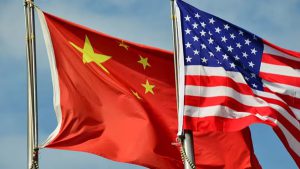
Beijing. Responding to recent restrictive measures by the US, China has imposed export controls on 10 US military-related companies. Additionally, a ban has been placed on government procurement from 46 US defense firms. This move by China follows US decisions to exclude several major Chinese technology companies from defense contracts.
In a statement issued on Monday, China’s Ministry of Commerce announced that domestic companies would no longer export “dual-use” items to these 10 US firms. Dual-use items are those that can be utilized for both civilian and military purposes. According to the ministry, this decision was taken to safeguard national security interests and in response to the US administration’s allegedly unjustified expansion of its list of Chinese military companies.
The restricted entities include US companies involved in military drone manufacturing and rare mineral resources. Meanwhile, China’s Ministry of Finance has issued directives prohibiting government institutions from purchasing products from 46 US defense companies. This list includes major firms such as Lockheed Martin and Raytheon Missiles & Defense.
However, China has clarified that if there is a genuine need for a specific item, the relevant companies may apply for export permission.
Controversy Surrounding Alibaba and Byju’s
Earlier this month, the US Department of Defense added several Chinese technology companies—including Alibaba and Byju’s—to a list of entities alleged to have ties to the Chinese military. Byju’s had dismissed these allegations as completely baseless.
Once included on the US list, these companies become ineligible for any contracts associated with the US military. China criticized the move, stating that it contradicted the agreements reached between President Xi Jinping and Donald Trump in May. Ongoing Clash Over Technology and Trade
Trade tensions between China and the United States have persisted for several years. This dispute is not limited merely to import tariffs; it has expanded to encompass competition over technological dominance, strategic supply chains, and advanced technology sectors.
The US has imposed additional import tariffs on Chinese products across multiple rounds, prompting China to retaliate with counter-tariffs on American goods and agricultural products. Concurrently, competition between the two nations has intensified regarding cutting-edge technologies such as semiconductors, artificial intelligence (AI), and quantum computing. Consequently, both sides have frequently resorted to export controls and other restrictive measures.
Experts believe that this escalating tension between the world’s two largest economies could have far-reaching implications for global trade, investment, and the technology industry.
Share:














Indore (HO)
Bhopal
Jabalpur


©2026 Agnibaan , All Rights Reserved