
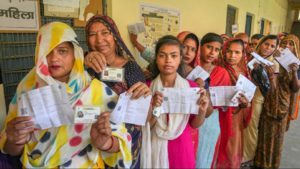
New Delhi: Rajasthan has begun voting in the first phase of its 2026 Urban Local Body elections, with polling underway across 162 urban local bodies and 5,393 wards in 39 districts. More than 57.5 lakh voters will decide the fate of 20,623 candidates in what is being closely watched as the first major electoral test of the state’s ‘One State, One Election’ approach. The BJP faces a crucial challenge in retaining its urban strongholds, while the Congress is seeking to regain lost ground at the grassroots level.
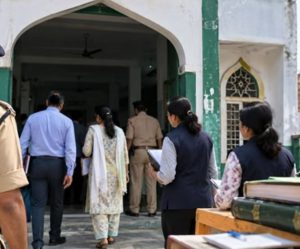
The State Election Commission has tightened security arrangements to ensure the voting process is peaceful and fair. Additional police forces have been deployed at sensitive and hyper-sensitive polling stations. Furthermore, arrangements for CCTV surveillance and webcasting at the booths have been put in place.
Contest Across 5,393 Wards in 39 Districts
Voting is taking place in 5,393 wards across 39 districts of Rajasthan during this first phase. A total of 20,623 candidates are in the electoral fray, and 5,752,278 voters will decide their political future.
Votes are also being cast today for ward councilors in four municipal corporations: Alwar, Bharatpur, Bikaner, and Bhilwara. Meanwhile, elections for the major municipal corporations of cities like Jaipur, Jodhpur, and Kota will be held in the second phase.
However, voting is being conducted in the first phase for 18 other urban local bodies in Jaipur district, including areas such as Chomu, Bagru, and Shahpura.
Contest in 27 Municipal Councils
Elections for wards in 27 municipal councils are also taking place during this first phase. These include Nagaur, Beawar, Kotputli, Churu, Sujangarh, Dholpur, Sawai Madhopur, Shahpura, Chomu, Fatehpur, Jhunjhunu, Jalore, Baran, Bundi, Jhalawar, Banswara, Chittorgarh, Pratapgarh, Dungarpur, Didwana-Kuchaman, Karauli, Bhiwadi, Khairthal-Tijara, Jaisalmer, and Barmer.
Additionally, elections for the post of councilor are being held in the wards of 131 municipalities. These include Kekri, Pisangan, Sarwar, Nasirabad, Sawar, Tantoti, Jayal, Mundwa, Basni, Kuchera, Niwai, Peeplu, Deoli, Uniara, Dooni, Vijayanagar, Masuda, Bigod, Pawta-Pragpura, Viratnagar, Narayanpur, Bansur, Suratgarh, Shri-Vijayanagar, Raisinghnagar, Anupgarh, Gharsana, Nohar, Bhadra, Sangaria, Tibbi, Rawatsar, Rajgarh, Ratannagar, Chhapar, Bhusawar, Rupbas, Rajakhera, Maniya, Saipau, Bonli, and Khandar, among others.
Voting is also taking place in the first phase for the municipalities of Bagru, Chaksu, Jobner, Kishangarh-Renwal, Phulera, Sambhar, Bassi, Dudu, Jamwaramgarh, Kaladera, Kanota, Khejroli, Manoharpur, Narayana, Phagi, and Vatika in Jaipur district.
BJP Faces Challenge to Retain Urban Strongholds
The results of the first phase will be particularly significant for the BJP. This marks the party’s first major electoral test among urban voters since the Bhajanlal Sharma government assumed power in December 2023. Following the decision to conduct local body elections under the ‘One State, One Election’ framework, the results can also be viewed as a reflection of public sentiment regarding the government’s performance and policies. Urban local bodies in Rajasthan have long been considered strongholds of the BJP. Consequently, the party faces the challenge of maintaining its influence in municipal corporations such as Bikaner, Bhilwara, Alwar, and Bharatpur.
This time, the BJP has denied tickets to several incumbent councilors, opting instead to field new faces. This has led to resentment among leaders who were denied tickets and raised the issue of rebels entering the fray as independent candidates. The party faces the challenge of curbing internal sabotage and managing these rebels.
An Opportunity for Congress to Regain Lost Ground
These elections are equally significant for the Congress. Following the Assembly and Lok Sabha elections, the party is striving to strengthen its foothold in Rajasthan’s urban areas. The local body elections offer an opportunity for a comeback at the grassroots level.
Under the leadership of State President Govind Singh Dotasra, former Chief Minister Ashok Gehlot, and Leader of the Opposition Tikaram Jully, the Congress has prioritized local issues during its campaign. The party has made sanitation, roads, electricity, and the alleged failures of the local administration key election issues.
5.8 Million Young Voters Could Shift the Equation
The role of young voters will be crucial in these elections. There are approximately 2.13 million voters in the 18–25 age group, while the 26–35 age group comprises about 3.66 million voters. In total, around 5.8 million voters aged 18 to 35 will cast their ballots.
Additionally, the number of Gen-Z voters (aged 18–29) stands at approximately 3.5 million, representing about 25 percent of the total electorate. Consequently, issues concerning the youth—such as local amenities, employment, and urban infrastructure—could play a pivotal role in shaping the election results.
The Real Test Lies After the Results
With the commencement of the first phase of voting, the process of gauging strength at the local level has begun for the BJP, the Congress, and regional parties. The BJP faces the challenge of retaining its urban support base amidst the government’s track record, whereas for the Congress, this presents an opportunity for a comeback in local politics. Furthermore, the results of these elections—held under the ‘One State, One Election’ framework—will be considered significant for Rajasthan’s future political trajectory.
Share:










Indore (HO)
Bhopal
Jabalpur


©2026 Agnibaan , All Rights Reserved