
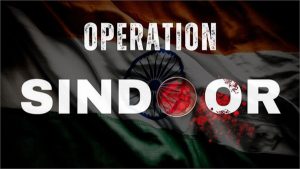
New Delhi: Today marks exactly one year since the launch of ‘Operation Sindoor’—an operation conducted by India to dismantle terrorist hideouts within Pakistan. On April 22, 2025, following a terrorist attack in Pahalgam that claimed the lives of 26 people, India refused to simply overlook Pakistan’s nefarious conspiracy and hostile actions; instead, Indian forces once again crossed the border into Pakistan and destroyed multiple terrorist bases. Furthermore, when the Pakistani military attempted to shield the terrorists under its protection, India targeted their military installations as well, inflicting heavy damage upon them.
However, India’s response was not limited solely to Operation Sindoor; to eliminate the terrorists responsible for the Pahalgam attack, Indian security forces executed a second operation—’Operation Mahadev.’ Through this operation, the perpetrators behind the massacre of innocent civilians—who had remained at large for several months—were finally tracked down and eliminated.
How did India exact retribution for the Pahalgam terrorist attack? Under Operation Sindoor, how did India dismantle Pakistan’s terrorist infrastructure? Subsequently, when the Pakistani military attempted to provoke a war with India, how did our armed forces target and obliterate key enemy positions? Let’s find out…
What unfolded in the aftermath of the Pahalgam terrorist attack, when the region was engulfed in mourning?
April 23, 2025
On the day the Pahalgam terrorist attack took place, Prime Minister Modi was in Saudi Arabia. Upon receiving news of the incident, the Prime Minister immediately cut short his official visit and returned to India. The following day—April 23—the Prime Minister convened a meeting of the Cabinet Committee on Security (CCS), following which India announced the suspension of the Indus Waters Treaty. Additionally, the Attari border was closed, SAARC visas issued to Pakistanis were revoked, and the staff strength of the Pakistani High Commission was reduced from 55 to 30. On the same day, Union Home Minister Amit Shah visited Srinagar and held a high-level security meeting. To assist with the investigation, the National Investigation Agency (NIA) arrived at the scene, and the Jammu and Kashmir Police released sketches of the terrorists.
April 24, 2025
In response to India’s stringent measures, Pakistan suspended the Shimla Agreement, closed its airspace to Indian flights, shut down the Wagah border for trade, and halted SAARC visas for Indians.
The Central Government convened an all-party meeting to brief the opposition. On this same day, an encounter took place in Basantgarh, Udhampur, in which an Indian soldier was martyred. During the night, cross-border firing erupted between the two nations along the Line of Control (LoC).
April 25 – May 6, 2025
Border Tensions and Ceasefire Violations: Along the Line of Control (LoC), Pakistan repeatedly violated the ceasefire and engaged in shelling, to which Indian forces responded with vigilance. On April 25, Indian Army Chief General Upendra Dwivedi visited Kashmir to assess the security situation.
April 26, 2025
Meanwhile, ‘The Resistance Front’ (TRF)—which had initially claimed responsibility for the Pahalgam terror attack—retracted its earlier statement and denied any role in the attack. Concurrently, the Upper House of Pakistan’s Parliament (the Senate) passed a resolution criticizing the suspension of the Indus Waters Treaty. Pakistani Prime Minister Shehbaz Sharif called for an impartial international investigation.
April 27, 2025
Acting on the orders of the Ministry of Home Affairs, the NIA officially took over the investigation into this terror attack. Meanwhile, the Indian Navy successfully conducted an anti-ship firing test to send a strong message regarding its strike capabilities. April 28, 2025
On April 28, a special session of the Jammu and Kashmir Legislative Assembly was convened, during which a resolution condemning the attack was passed.
April 30, 2025
On April 30, incidents of cross-border firing occurred between the two nations along both the Line of Control and the International Border.
On the very same day, India’s Ministry of External Affairs briefed the ambassadors of 45 countries regarding the full details of this terrorist attack.
May 7, 2025
In the early hours of May 7, India launched ‘Operation Sindoor.’ Indian forces carried out precision airstrikes on nine terrorist training camps located in Pakistan and Pakistan-occupied Kashmir (PoK). Several terrorists were killed in these strikes, and the terrorist infrastructure was destroyed. More than 100 terrorists were killed in these attacks by India.
Following the success of this operation, Prime Minister Narendra Modi clarified that ‘Operation Sindoor’ has established a new defense doctrine: “Any terrorist attack on India will exact a heavy price—not only from the terrorists themselves but also from their handlers (Pakistan); furthermore, India will not bow down in the face of nuclear threats.”
This major Indian offensive against terrorists left Pakistan—the terrorists’ safe haven—suddenly rattled. Consequently, between the night of May 7 and May 9, the Pakistani military launched attacks using missiles and approximately 300–400 drones against various parts of India (specifically, urban areas across Jammu & Kashmir, Punjab, Gujarat, etc.). However, their missiles and drones proved ineffective against India’s air defense systems.
Interestingly, while not a single Pakistani attack succeeded in inflicting any damage upon India, the Indian Air Force, through precision strikes, neutralized Pakistan’s air defense systems and destroyed 11 airbases in rapid succession. During this period, India struck a total of 13 Pakistani military installations. These strikes targeted everything from runways to aircraft bunkers, effectively crippling the operational capabilities of the Pakistan Air Force. Ultimately, India’s strike on an airbase near Kirana Hills proved decisive, prompting Pakistan to appeal to US President Donald Trump for a ceasefire.
How Did Operation Sindoor End?
Operation Sindoor concluded on May 10, 2025, when Pakistan—overwhelmed by India’s relentless attacks—sought assistance from the United States. At one juncture during the conflict, Prime Minister Modi had explicitly conveyed to US Vice President J.D. Vance that he was determined to teach Pakistan a lesson through this war. However, when Pakistani military officials subsequently appealed for a ceasefire, India—having achieved its strategic objectives—agreed to the request. On May 10, 2025, at 3:30 PM, Pakistan’s Director General of Military Operations (DGMO) called his Indian counterpart directly and, acknowledging his inability to withstand further attacks, pleaded with India to halt its military operations. It was agreed that all military operations—across land, sea, and air—would cease effective 5:00 PM on May 10. This ceasefire was not a formal or legally binding agreement, but rather merely a verbal military understanding.
Share:












Indore (HO)
Bhopal
Jabalpur


©2026 Agnibaan , All Rights Reserved