
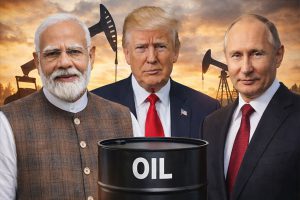
Washington. Citing national interest, U.S. President Donald Trump has issued an order granting exemptions from sanctions, restrictions, and tariffs that were set to be imposed under legislation targeting Russia and Iran. This decision by Donald Trump regarding the purchase of Russian oil and gas brings significant relief to India and China. The move is being viewed as a major U-turn by the U.S. President.
In an executive order issued on Friday evening, Trump stated, “I hereby waive the application of such sanctions, restrictions, and tariffs” as provided for under the relevant legislation. He asserted that granting such exemptions at this time is in the national interest of the United States and has submitted a certification to Congress to this effect. It should be noted that these sanctions and tariffs were slated to take effect under a bill signed by Trump just last month; he made this decision only one day before they were due to come into force.
Why did Trump make this U-turn?
This executive order comes at a time when Trump appears to be adopting a softer stance toward Russia. He has publicly criticized Ukrainian President Volodymyr Zelenskyy, even suggesting that Ukraine should elect a new leader.
Last week, Trump announced an agreement with Russian President Vladimir Putin, under which Russia will supply diesel to the United States. According to the deal, Russia will immediately ship over 300,000 tonnes of diesel, with further consignments to follow in the coming months.
Zelenskyy criticized the diesel agreement between the U.S. and Russia, describing it as “unbecoming of our partners” and a “weak decision.” He further alleged that Moscow is expressing its “gratitude” for this agreement by launching attacks on Ukraine.
What would the impact have been on India? Had Trump imposed a 100 percent tariff on India, it would have been in addition to the 10 percent duty already levied by the U.S. on Indian imports. The U.S. had imposed this 10 percent tariff, alleging that India had failed to take sufficient measures to prevent the import of goods produced using forced labor. However, the actual impact of any new tariffs on Indian exports could only have been assessed following an official announcement of the tariff rates.
Tensions between India and the U.S. escalated last year over India’s import of crude oil from Russia. At that time, Trump imposed an additional 25 percent tariff on Indian imports, citing India’s purchase of oil from Russia. This levy was in addition to an existing 25 percent retaliatory tariff. However, the additional tariff was removed in February 2026, and the retaliatory tariff—under the India-U.S. trade framework—was reduced to 18 percent.
How did India respond?
Following the passage of a bill by the U.S. Congress last month that imposed sanctions on Russia, India clarified that it remains committed to taking all necessary steps to protect its trade and economic interests.
In a statement, the Ministry of External Affairs noted, “As has been stated on several previous occasions, India is fully committed to ensuring the energy security of its 1.4 billion people. To this end, it will continue to source energy from a diverse range of suppliers and make decisions based on evolving market conditions.”
What is this bill?
The legislation, titled the “Lindsey O. Graham Sanctioning Russia and Iran Act of 2026,” was named after Senator Lindsey Graham. Graham was one of the most prominent supporters of Ukraine within the U.S. Congress. He passed away shortly after returning from a visit to Kyiv in July of this year. Under this law, Trump was given 30 days to impose a 100 percent tariff on all goods arriving from five major countries—China, India, Slovakia, Hungary, and Azerbaijan—that purchase crude oil from Russia. Furthermore, the law included provisions to impose sanctions on several Russian entities and to apply a 500 percent tariff on all Russian energy products imported into the United States. This one-month deadline was set to expire on October 18.
Share:









Indore (HO)
Bhopal
Jabalpur


©2026 Agnibaan , All Rights Reserved