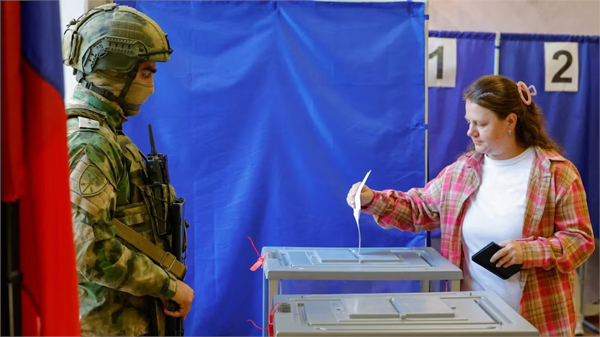

New Delhi: The voting in the first phase of the West Bengal Assembly elections has, this time around, taken both political pundits and political parties by surprise. The voter turnout figures emerging from the first phase have shattered all previous records. A turnout of over 92 percent was recorded across 152 seats—a figure that could potentially rise to 93 percent in the final tally.
If this trend holds, it would represent an increase of nearly 10 percent compared to the 83.2 percent turnout recorded in the first phase of the 2021 Assembly elections. This surge in voter turnout has now become the central political question: Did it swing in favor of “Didi” (Mamata Banerjee), or is it creating an opportunity for “Delhi”—that is, the BJP?
Following the conclusion of voting in West Bengal and Tamil Nadu, Chief Election Commissioner Gyanesh Kumar issued a statement saluting every voter who exercised their franchise, as well as their spirit and enthusiasm. He remarked that this represents the highest voter turnout graph recorded since India’s independence.
In the last 45 Assembly elections held across the country, whenever the voter turnout percentage remained lower than or stayed roughly the same as the previous election, the incumbent government benefited in the majority of states. For instance, in Madhya Pradesh, when the turnout percentage shifted from 75 percent to 76 percent, the BJP government successfully retained power. Similarly, in Uttar Pradesh, when the turnout dipped from 61 percent to 60 percent, the BJP still managed to return to power. And in Goa, even when the turnout dropped by 4 percent, the BJP government once again returned to office.
However, there have been some exceptions to this trend. In states such as Chhattisgarh, Rajasthan, Telangana, and Punjab, governments changed hands—whether the turnout was marginally lower (by one or two percent) or marginally higher (by one or two percent). Nevertheless, when viewed in the broader context—the “big picture”—voting patterns suggest that a surge of 7 percent or more carries two distinct implications: either the electorate intends to bring the incumbent government back to power with overwhelming force, or they intend to oust it with equal intensity. In the presence of such distinct voting patterns, election outcomes rarely end in a deadlock or a close contest. Rather, with such voting patterns, elections become clear-cut and decisive battles.
Voting Percentage in 16 Districts: Where and How Much?
On Thursday, voting took place across 152 seats in 16 districts of West Bengal; in 12 of these districts, the voter turnout stood at 90 percent or higher. Among these, the highest turnout was recorded in South Dinajpur, where 94.4 percent of the people cast their votes. To put it simply, this means that in South Dinajpur, approximately 95 out of every 100 voters visited the polling stations to cast their ballot. South Dinajpur comprises a total of 6 Assembly seats, where the Muslim population stands at approximately 25 percent, while the Hindu population is 73.5 percent. In other words, the highest voter turnout was recorded in the very district where Hindu voters hold the decisive influence.
Following South Dinajpur, Cooch Behar district recorded a turnout of 94 percent; Birbhum saw 93.2 percent; Jalpaiguri recorded 92.7 percent; and Murshidabad district also witnessed a nearly identical turnout of 92.7 percent. Murshidabad accounts for 22 of West Bengal’s Assembly seats. Furthermore, Hindus constitute a minority in this district. Here, the Muslim population exceeds 65 percent, whereas the Hindu population stands at a mere 33 percent; until now, Chief Minister Mamata Banerjee’s TMC had been the dominant force in this district. However, Humayun Kabir has now emerged as a formidable challenge to the party.
Will Humayun Kabir Pose a Challenge to the TMC?
Humayun Kabir is the very leader who is currently constructing a mosque—reminiscent of the Babri Masjid—in Murshidabad, and he has contested the elections under the banner of his own independent party. If Humayun Kabir succeeds in splitting the Muslim vote, the electoral equations in at least 13 seats within Murshidabad are bound to undergo a significant shift. Moreover, the BJP stands to gain from the political tussle between Humayun Kabir and the TMC in this region. To understand precisely how Humayun Kabir might impact the political landscape in Murshidabad, it is essential to closely examine the following statistics. Humayun Kabir is contesting the election from the Rejinagar seat, where voter turnout stood at 85.5 percent in 2021; however, this time around, voting here has reached 91.2 percent. The second seat from which Humayun is contesting is named Naoda. During the previous election, this seat recorded a turnout of 86.2 percent, but this time, voting here has also surged to 93 percent. Now, the entire political game in Murshidabad hinges on the extent to which Humayun manages to make inroads into Mamata Banerjee’s Muslim vote bank, and the degree to which this ultimately benefits the BJP.
The Hindu-Muslim Voter Dynamic in Phase 1 Seats
Another significant feature of the first phase of voting is that the seats recording the highest voter turnout are predominantly “mixed” constituencies. This implies that in these specific seats, both Muslims and Hindus constitute a majority within their respective segments of the population. For instance, the Bhagawangola seat in Murshidabad witnessed a voter turnout of 96.5 percent; notably, Muslims account for 85 percent of the population in this constituency, while Hindus make up a mere 14.2 percent.
Following this, Raghunathganj recorded a turnout of 96.3 percent—a seat also located within Murshidabad—where 80 percent of the electorate consists of Muslim voters. Similarly, the Lalgola seat—also in Murshidabad—saw a turnout of 96 percent; here too, Hindus are in the minority, while the Muslim population exceeds 80 percent. The Farakka seat recorded a turnout of 95.7 percent, with a demographic breakdown of 67 percent Muslims and 32 percent Hindus. In contrast, the Jangipur seat witnessed a turnout of 94.8 percent, comprising a population mix of 62 percent Muslims and 37 percent Hindus.
Even in constituencies where Hindus constitute the majority, there has been a robust voter turnout; however, compared to Muslim-majority seats, the average turnout in Hindu-majority seats has been lower by approximately 2 to 2.5 percent. It is precisely within this statistic that the entire outcome of the first phase of voting lies hidden. A pertinent question arising here is whether this high voter turnout has bolstered the BJP’s prospects. This question gains significance because, until now, the BJP has consistently alleged that—out of fear of the TMC—a large number of people were unable to cast their votes in a “fear-free” environment, that is, without intimidation.
Will the BJP Benefit from Fear-Free Voting?
However, given the manner in which 240,000 personnel of the Central Security Forces were deployed this time—and the fact that voting remained largely peaceful across most constituencies—the question now being raised is whether the large number of people who stepped out to vote were indeed able to exercise their franchise without fear. And if this truly represents “fear-free voting,” is the BJP poised to reap the benefits?
This time around, the morning of the election in Bengal felt distinct from that of several previous polls. Barring a few sporadic skirmishes, the usual din of chaos and violence was almost entirely absent. There were neither bomb blasts nor the terror of booth capturing. The Election Commission effectively transformed Bengal into a fortified cantonment, and the 240,000 personnel of the Central Forces achieved what had hitherto seemed impossible. In previous elections, violence had occurred on a massive scale; during the last Assembly elections, for instance, there were 1,300 violent incidents resulting in 17 fatalities. This time, however, such incidents were limited in scope, and many potential disturbances were successfully averted.
In political circles, the most intense topic of discussion revolves around the “silent voter.” Political analysts believe that when voting takes place free from pressure and fear, the “anti-incumbency” wave—the sentiment against the ruling dispensation—becomes most pronounced. If the average citizen of Bengal is casting their vote without any hesitation, it signals that the political landscape of the state is undergoing a significant shift. However, the question remains: will this wave be strong enough to propel the BJP across the magical threshold of a legislative majority? That suspense will only be resolved on May 4th. It is noteworthy that in 2021, the BJP was restricted to just 77 seats; at that time, violence and fear were considered decisive factors. However, this first phase of the 2026 elections has clarified the picture: the people of Bengal have chosen either change or overwhelming support. The deployment of security forces has provided the BJP with the level playing field it has been pleading for for years. Now, only one question remains: Is ‘Didi’s’ impregnable fortress about to crumble, or will the BJP’s hopes once again stall right at the threshold of power?
In the previous elections, the BJP secured victory in 77 seats, while the TMC won 215. To overturn those previous election results, the BJP would need to win approximately 100 additional seats this time around. In this context, the first phase of the election becomes critically important regarding those 100 seats. The reason is that voting in the first phase took place across 152 seats spanning 16 districts of West Bengal—of which the BJP had won 59 and the TMC 92 in the previous election.
If the BJP manages a major upset—winning 92 seats this time while the TMC is limited to 59—the BJP could potentially reach the 170-seat mark. To achieve this, it would need to win at least 92 seats in the first phase and 78 seats out of the 141 seats contested in the second phase. The combined tally of these two phases would then amount to the 170-seat figure. However, this will not be an easy task for the BJP.
Share:












Indore (HO)
Bhopal
Jabalpur


©2026 Agnibaan , All Rights Reserved