
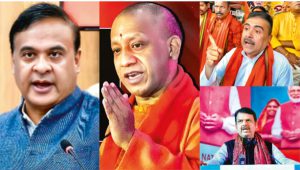
New Delhi: Over the past five years, the emergence of strong regional leaders has effectively resolved the issue of a potential future leadership crisis for the BJP. The party already boasts strong regional stalwarts in the North—Yogi Adityanath—and in the West—Devendra Fadnavis. Furthermore, recent assembly elections have now delivered new, firebrand Hindutva leaders in the Northeast—Himanta Biswa Sarma—and in the East—Suvendu Adhikari. Joining this league, the Chief Ministers of Odisha and Bihar—Mohan Charan Majhi and Samrat Choudhary, respectively—are currently in the process of proving their mettle. An interesting fact is that all these regional stalwarts fall within the 50-to-60 age bracket.
Among these new regional leaders, Yogi, Suvendu, and Himanta stand out as firebrand proponents of Hindutva, while Fadnavis has cultivated an image as an astute strategist. Meanwhile, having assumed the office of Chief Minister, Samrat has begun to strictly implement—on the ground—the crucial advice received from the central leadership regarding the restoration of law and order. Evidence of this approach is visible in Bihar through the police-led campaigns launched to root out criminals, as well as the deployment of “bulldozer services.”
All Eyes on Suvendu
Himanta, who single-handedly steered the party to electoral victory in Assam on the strength of aggressive Hindutva, has already proven his capabilities. Now, all eyes are fixed on Suvendu, who has defeated Mamata Banerjee in two consecutive elections. The responsibility now rests upon him to transform the most pivotal state in the East into a new laboratory for Hindutva politics, modeled after Gujarat. Distancing himself slightly from the BJP’s official slogan of “Sabka Saath, Sabka Vikas” (Support of All, Development for All), he has signaled a shift toward aggressive Hindutva politics by adopting the slogan: “Jo hamare saath, hum uske saath” (We stand with those who stand with us). Now, Efforts Underway to Address Shortcomings in the South
The BJP faces a specific challenge in South India when it comes to cultivating a strong new generation of leaders. At one point, the party had secured a pivotal figure in Karnataka in the form of B.S. Yediyurappa. Currently, however, the party is struggling to achieve success in Telangana, Karnataka, Kerala, and Tamil Nadu in line with its strategic objectives.
A Message Also Conveyed
By appointing Himanta and Samrat Chaudhary as Chief Ministers—and by elevating Subhendu to a position of prominence—the party has signaled its willingness to entrust key posts to leaders who have joined its ranks from other political backgrounds. *All Have 15 to 20 Years Ahead:* These leaders, who have emerged as the new regional stalwarts of the next generation, are all under the age of 58. Himanta and Samrat are 57; Subhendu and Fadnavis are 55; Mohan Charan Majhi is 54; and Yogi is a mere 53 years old. If the age of 75 is taken as the benchmark for active service, these formidable regional leaders have a substantial window—ranging from 18 to 22 years—during which they can continue to serve the party. Currently, following the party’s first-generation stalwart—Prime Minister Modi—the next most prominent leader is Amit Shah, who is 61 years old. Meanwhile, the party’s National President, Nitin Nabin, is just 45 years old.
Share:










Indore (HO)
Bhopal
Jabalpur


©2026 Agnibaan , All Rights Reserved